

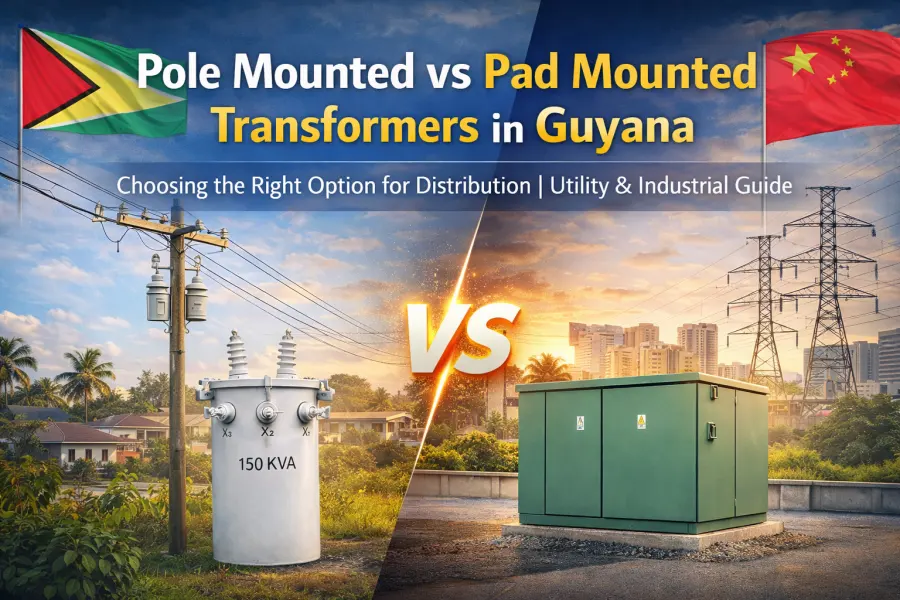
As Guyana continues to upgrade and expand its power distribution infrastructure, utilities, EPC contractors, and industrial project owners are increasingly faced with a key technical decision: which type of distribution transformer is best suited for the application.
Among the most commonly used solutions are pole mounted transformers, pad mounted transformers, and three phase oil filled distribution transformers installed in substations. Each type serves a specific role in Guyana’s power network, depending on load demand, installation environment, safety requirements, and budget.
This article explains the key differences between pole mounted and pad mounted transformers, how they are used in Guyana, and how buyers can source the right solution efficiently from international manufacturers.
Overview of Common Distribution Transformer Types in Guyana
In Guyana, medium voltage distribution networks typically operate at voltage levels such as 12.47 kV, 13.2 kV, and 13.8 kV, stepping down power to low voltage for residential, commercial, and industrial use.
The most common transformer configurations include:
-
Pole mounted transformers for overhead distribution lines
-
Pad mounted transformers for underground or urban networks
-
Oil filled distribution transformers installed in utility substations
Understanding the characteristics of each option is essential for selecting a reliable and cost-effective power solution.
Pole Mounted Transformers: Practical and Cost-Effective
Pole mounted transformers are widely used across Guyana, particularly in suburban, rural, and semi-industrial areas where overhead distribution lines are common.
Key advantages of pole mounted transformers include:
-
Lower installation cost compared to ground-mounted units
-
Minimal land use requirements
-
Simple integration with overhead lines
-
Proven reliability for residential and light commercial loads
Typical capacities range from 15 kVA to 500 kVA, although higher ratings may be used depending on network design. Pole mounted transformers are usually oil filled and designed for outdoor operation in tropical climates.
For utilities seeking rapid network expansion with controlled investment, pole mounted transformers remain a practical choice.
Pad Mounted Transformers: Enhanced Safety and Urban Compatibility
Pad mounted transformers are increasingly adopted in Guyana’s urban developments, commercial zones, and industrial parks where underground cable systems are preferred.
Compared to pole mounted units, pad mounted transformers offer:
-
Improved public safety with tamper-resistant enclosures
-
Cleaner aesthetics for residential and commercial areas
-
Better protection against environmental exposure
-
Compatibility with underground distribution networks
Pad mounted transformers are commonly supplied in capacities from 100 kVA to 5000 kVA, with medium voltage primary ratings such as 13.8 kV and low voltage outputs like 480Y/277 V or 208Y/120 V.
They are well suited for shopping centers, hospitals, office complexes, and infrastructure projects where safety and appearance are critical.
Substation Distribution Transformers: Higher Capacity and Load Stability
For higher load demand and centralized power distribution, three phase oil filled distribution transformers installed in substations are the preferred solution.
These transformers typically serve:
-
Industrial facilities and manufacturing plants
-
Utility substations supplying large service areas
-
Renewable energy projects and infrastructure systems
Capacities commonly range from 500 kVA to 5000 kVA and above, offering stable voltage regulation, higher short-circuit withstand capability, and long-term operational reliability.
Key Factors When Choosing the Right Transformer Type
When selecting between pole mounted, pad mounted, or substation transformers in Guyana, buyers should consider several critical factors.
Load demand is the first consideration. Smaller residential loads are well served by pole mounted transformers, while higher commercial and industrial loads may require pad mounted or substation solutions.
Installation environment is equally important. Urban and high-traffic areas often favor pad mounted transformers due to safety and aesthetics, while rural areas benefit from pole mounted installations.
Budget and lifecycle cost should also be evaluated. While pad mounted transformers have higher initial costs, they may offer long-term benefits in safety and maintenance.
Why Many Guyana Projects Source Transformers from China
An increasing number of Guyana utilities and EPC contractors source pole mounted, pad mounted, and distribution transformers from China due to several advantages:
-
Competitive factory-direct pricing
-
Wide capacity and voltage customization options
-
Experience with international standards such as ANSI, IEC, and IEEE
-
Established export logistics to Latin America and the Caribbean
Chinese manufacturers today supply transformers to diverse global markets, making them capable partners for Guyana’s evolving power infrastructure.
PowerNex: Supplying Transformer Solutions for Guyana
PowerNex is a China-based power transformer manufacturer specializing in pole mounted transformers, pad mounted transformers, and three phase oil filled distribution transformers up to 35 kV.
With a focus on utility, industrial, and infrastructure projects, PowerNex provides:
-
Factory-direct wholesale supply
-
Customized voltage and capacity configurations
-
Compliance with international standards
-
Technical support from specification to delivery
These capabilities make PowerNex a reliable partner for power distribution projects in Guyana and beyond.
Conclusion
Choosing between pole mounted, pad mounted, and substation distribution transformers is a critical decision for power projects in Guyana. By understanding application requirements, load characteristics, and installation environments, buyers can select the most suitable solution.
With careful supplier selection and clear technical specifications, sourcing transformers from experienced manufacturers such as PowerNex can help ensure reliable, efficient, and cost-effective power distribution for Guyana’s growing energy needs.