

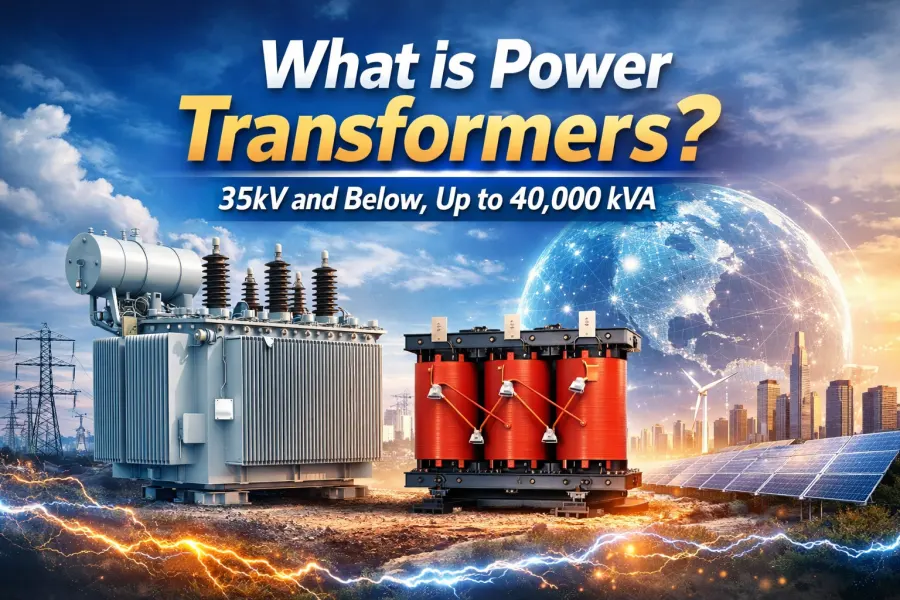
In today’s global power industry, power transformers are indispensable for reliable electricity transmission and distribution. But what is power transformers, and how do they function in modern electrical systems? This comprehensive guide explains everything you need to know about 35kV and below transformers with capacities up to 40,000 kVA, including their design, materials, applications, testing, global brands, pricing, and advantages.
1. What is Power Transformers? – Definition and Purpose
A power transformer is an electrical device designed to transfer electrical energy between circuits while changing voltage levels. Its primary purposes include:
-
Voltage conversion: Step up voltage for long-distance transmission or step down for safe usage
-
Power transmission efficiency: Reduce energy losses in industrial, commercial, and urban grids
-
System reliability: Provide stable and continuous power for critical applications
35kV and below power transformers are typically used in:
-
Industrial factories and manufacturing plants
-
Commercial buildings, shopping malls, and hospitals
-
Urban electricity distribution networks
-
Renewable energy power stations (solar PV and wind farms)
Globally, medium- and low-voltage transformers dominate urban and industrial power distribution, making them a backbone of modern electricity systems.
2. Technical Specifications of 35kV and Below Power Transformers
Understanding the technical specifications of a power transformer is crucial for selecting the right solution. For 35kV and below transformers with capacities up to 40,000 kVA, the key specifications are:
| Parameter | Specification |
|---|---|
| Rated Voltage | ≤ 35kV |
| Maximum Capacity | 40,000 kVA |
| Winding Material | High-conductivity copper or aluminum |
| Core Material | Cold-rolled silicon steel or amorphous alloy |
| Cooling Method | ONAN / ONAF (Oil Natural / Oil Forced), Dry-type Air Cooling |
| Insulation Class | Class A to F (up to 155°C) |
| Frequency | 50 Hz / 60 Hz |
These specifications ensure high efficiency, stable operation, and long-term reliability for industrial, commercial, and urban grid applications.
3. What is Power Transformers Made Of? – Core Components and Materials
The performance of a power transformer depends heavily on materials and design. The core components include:
Transformer Core
-
Material: High magnetic conductivity silicon steel or amorphous alloy
-
Function: Minimizes core losses, improves energy efficiency
-
Advantage: Amorphous alloy cores reduce no-load losses by 50–70% compared to conventional silicon steel
Windings
-
Copper windings: Excellent electrical conductivity and thermal stability
-
Aluminum windings: Lightweight, cost-effective, suitable for larger capacity units
Insulation System
-
Paper-oil insulation: Common in oil-immersed transformers for high-load applications
-
Epoxy resin insulation: Used in dry-type transformers, environmentally friendly and safe
Cooling System
-
ONAN: Oil Natural Air Natural
-
ONAF: Oil Natural Air Forced
-
Dry-type Air Cooling: Suitable for indoor environments or urban installations
Optimizing these components ensures low losses, long service life, and reliable operation.
4. How Does Power Transformers Work? – Operating Principle
A power transformer operates on electromagnetic induction:
-
The primary winding is connected to an AC voltage
-
An alternating magnetic field is generated in the core
-
The secondary winding induces a voltage proportional to the turns ratio
Voltage is proportional to the turns ratio, and current is inversely proportional to voltage, enabling efficient power transfer.
For 35kV and below transformers, careful control of losses, temperature rise, and insulation safety is critical in design.
5. Applications of Power Transformers
Understanding what is power transformers used for helps clarify their importance. Key applications for 35kV and below transformers include:
-
Industrial Parks – Powering factories, heavy machinery, welding equipment, and production lines
-
Urban Distribution Networks – Stepping down high-voltage transmission lines for residential and commercial use
-
Renewable Energy Plants – Stepping up low-voltage electricity from wind turbines or solar PV for grid integration
-
Commercial Buildings – High-rise buildings, shopping centers, hospitals, and data centers
-
Public Infrastructure – Airports, subways, and hospitals requiring reliable electricity
Case studies show that medium- and low-voltage transformers account for over 60% of industrial and urban distribution applications worldwide.
6. Testing and Performance of Power Transformers
To ensure reliability, all PowerNex transformers undergo rigorous performance testing:
-
No-load test: Measures core losses and excitation current
-
Short-circuit test: Verifies winding and insulation withstand capabilities
-
Temperature rise test: Ensures safe operation under full load
-
Noise measurement: Confirms compliance with international noise standards
-
Insulation withstand voltage test: Ensures safety and prevents breakdown
Using high magnetic conductivity silicon steel or amorphous alloy cores can reduce no-load losses by 20–50%, offering significant long-term energy savings.
7. Global Brands of Power Transformers
For understanding the market, here’s a comparison of leading global power transformer brands:
| Brand | Country | Typical Capacity | Features | Price Range (USD) |
|---|---|---|---|---|
| Siemens | Germany | 10 kVA – 40,000 kVA | High efficiency, smart monitoring | 30,000 – 1,000,000 |
| ABB | Switzerland | 10 kVA – 35,000 kVA | High reliability, customization | 25,000 – 900,000 |
| Schneider Electric | France | 10 kVA – 30,000 kVA | Distribution optimization, energy saving | 10,000 – 600,000 |
| Mitsubishi Electric | Japan | 10 kVA – 40,000 kVA | High performance, durable | 35,000 – 1,200,000 |
| PowerNex Transformers | China | 10 kVA – 40,000 kVA | Cost-effective, customizable | 1,000 – 500,000 |
Chinese manufacturers like PowerNex offer competitive pricing with reliable performance, especially for mid- and low-voltage transformers.
8. Performance Indicators and Selection Guide
When selecting a power transformer, consider the following:
-
Capacity matching – Ensure rated capacity meets load requirements
-
Efficiency and losses – Minimize energy waste and reduce long-term operating costs
-
Insulation class – Ensures long-term safe operation
-
Cooling method – Choose oil-immersed or dry-type based on installation environment
-
Certifications – IEC, GB/T, ANSI compliance
-
After-sales service – Reliable support for maintenance and troubleshooting
PowerNex Transformers provides custom selection support to match clients’ exact requirements.
9. Global Price Range and Cost Analysis
For 35kV and below transformers, prices vary based on:
-
Voltage and capacity
-
Core material (silicon steel vs amorphous alloy)
-
Winding material (copper vs aluminum)
-
Cooling method (oil-immersed vs dry-type)
-
Customization requirements
Approximate price ranges:
| Capacity | Typical Price (USD) |
|---|---|
| 10 kVA – 500 kVA | 8,000 – 50,000 |
| 500 kVA – 5,000 kVA | 40,000 – 200,000 |
| 5,000 kVA – 40,000 kVA | 150,000 – 500,000 |
Chinese manufacturers offer 30–60% cost savings compared with European and Japanese brands for equivalent specifications.
10. Advantages of PowerNex Transformers
PowerNex Transformers provides unique advantages in the global transformer market:
-
Wide product range – 10 kVA – 40,000 kVA for medium- and low-voltage applications
-
High cost-performance – Competitive pricing without compromising quality
-
Customization – Voltage, capacity, cooling method, insulation tailored to projects
-
Advanced materials – High magnetic conductivity silicon steel, amorphous alloy, copper windings, high-performance insulation
-
Rigorous testing – Ensures reliability and compliance with international standards
-
Global supply and support – Asia, Europe, Africa, South America coverage with rapid response
-
Proven track record – Deployed in industrial parks, commercial buildings, renewable energy, and urban distribution projects
11. Conclusion – What is Power Transformers and Its Future
As global energy demand continues to grow and urbanization accelerates, medium- and low-voltage transformers will remain a cornerstone of modern power systems. 35kV and below transformers, with capacities ranging from 2,000 kVA, 2,500 kVA, 3,000 kVA, 3,500 kVA, 4,000 kVA, 5,000 kVA, up to 10 MVA, 20 MVA, 30 MVA, and 40 MVA, are essential for industrial parks, commercial buildings, urban distribution networks, and renewable energy projects worldwide.
PowerNex Transformers, a leading Chinese manufacturer, supplier, wholesaler, and factory, combines high cost-performance, advanced materials, and customization capabilities to deliver safe, efficient, and reliable power transformer solutions. Our extensive product line supports a wide range of voltage and capacity requirements, and we offer customized designs tailored to specific project needs, whether for industrial, commercial, or renewable energy applications.
With our factory-direct pricing, wholesale options, and global supply network, PowerNex ensures that clients can access high-quality Chinese-manufactured transformers at competitive prices without compromising performance. Our products are designed to meet international standards and are tested for efficiency, durability, and safety, giving clients confidence in long-term operation.
💡 Contact PowerNex Transformers today for detailed specifications, personalized quotations, and complete project solutions. Whether you need 2,000 kVA to 40 MVA transformers, custom voltage levels, or specialized industrial and renewable energy solutions, our team is ready to provide factory-direct, high-performance, and globally supplied transformers that ensure every kilowatt-hour is delivered efficiently, safely, and reliably.