

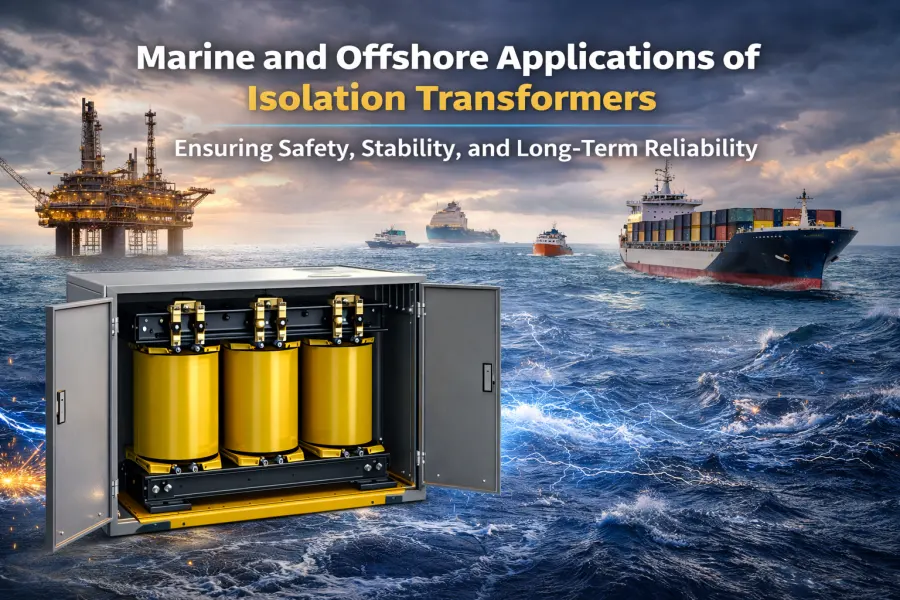
Marine and offshore environments are among the most demanding electrical application scenarios in the world. Ships, offshore platforms, ports, and coastal industrial facilities rely on stable, safe, and uninterrupted power systems to support navigation, propulsion, automation, communication, and safety-critical equipment.
In these environments, isolation transformers play a vital role. They provide electrical separation, suppress noise, stabilize voltage, and protect sensitive onboard and offshore equipment from electrical faults, ground loops, voltage spikes, and unstable power sources.
As a leading Chinese manufacturer, supplier, wholesaler, and factory, PowerNex delivers high-performance marine and industrial isolation transformers to global markets including the USA, Canada, Brazil, Argentina, Australia, Indonesia, Malaysia, Philippines, UAE, Saudi Arabia, Russia, Germany, France, South Africa, Venezuela, Mexico, New Zealand, and more. We support OEM & ODM customization to meet international marine standards and local grid requirements.
Why Marine and Offshore Environments Require Isolation Transformers
Marine and offshore electrical systems face challenges that are rarely encountered in standard industrial environments:
-
Salt-laden air causing corrosion
-
High humidity and condensation
-
Continuous vibration and mechanical shock
-
Limited maintenance access
-
Mixed power sources (shore power, generators, renewable energy)
-
International voltage and frequency differences
Isolation transformers are specifically designed to mitigate these risks by ensuring safe power distribution and equipment protection.
What Is a Marine Isolation Transformer?
A marine isolation transformer is a specially engineered transformer that electrically isolates onboard or offshore electrical systems from the primary power source while maintaining stable voltage output.
Core Functions
-
Electrical isolation for crew safety
-
Protection against ground faults
-
Reduction of electromagnetic interference (EMI)
-
Suppression of voltage spikes and harmonics
-
Improved reliability of marine electrical systems
Structural Characteristics
-
Dry-type or oil-filled design
-
Fully enclosed protective housing
-
Anti-corrosion coating
-
Marine-grade insulation materials
-
Shock and vibration-resistant mounting
Technical Advantages of Isolation Transformers in Marine & Offshore Applications
1. Enhanced Electrical Safety
Electrical isolation significantly reduces the risk of electric shock, especially in environments with high moisture levels. This is critical for protecting crew members and maintenance personnel.
2. Equipment Protection and Longevity
Marine electronics such as navigation systems, radar, communication devices, PLCs, and VFDs are highly sensitive to power disturbances. Isolation transformers prevent damage caused by transient voltage, surges, and unstable generators.
3. Noise and Interference Reduction
Isolation transformers effectively reduce EMI/RFI, ensuring stable operation of navigation, communication, and control systems.
4. Stable Voltage Output
Ships and offshore platforms often experience voltage fluctuations due to varying loads and generator performance. Isolation transformers provide consistent voltage output for critical equipment.
5. Compliance with International Standards
PowerNex isolation transformers comply with:
-
IEC standards
-
CE certification
-
Marine standards such as ABS, DNV, BV (customizable)
Key Marine and Offshore Applications
1. Commercial Vessels
-
Cargo ships
-
Tankers
-
Passenger ferries
-
Cruise ships
Isolation transformers support navigation systems, lighting, HVAC, propulsion controls, and onboard automation.
2. Offshore Oil & Gas Platforms
-
Drilling platforms
-
Floating production systems
-
Offshore substations
They ensure reliable power for safety systems, communication equipment, and industrial automation.
3. Ports and Shipyards
-
Shore-to-ship power systems
-
Dockside power distribution
-
Ship maintenance facilities
Isolation transformers protect equipment from unstable shore power and ground potential differences.
4. Offshore Renewable Energy
-
Offshore wind farms
-
Marine energy stations
They provide isolation and voltage stability for power conversion and grid integration systems.
Global Voltage Standards and Technical Parameters
North America (USA, Canada)
-
Voltage: 120/240V, 60Hz (single-phase)
-
208/480V, 60Hz (three-phase)
-
Common capacities: 45kVA–1000kVA
Europe (Germany, France, UK, etc.)
-
Voltage: 230/400V, 50Hz
-
IEC-compliant designs
-
High emphasis on EMI suppression
Middle East (UAE, Saudi Arabia)
-
Voltage: 220–240V / 380–415V, 50Hz
-
IP55–IP65 enclosures
-
High-temperature and sand-resistant designs
Asia-Pacific (Australia, Indonesia, Malaysia, Philippines)
-
Voltage: 220–240V, 50Hz
-
Mixed shore and generator power
-
Custom OEM voltage solutions
Latin America & Africa (Brazil, Argentina, South Africa, Mexico)
-
Mixed voltage standards (110–240V, 50/60Hz)
-
Unstable grid conditions
-
Heavy-duty isolation transformers for long-term reliability
Case Study 1: Offshore Oil Platform – UAE
Project Scope:
Supply isolation transformers for control, safety, and communication systems on an offshore oil platform.
Technical Specifications:
-
Voltage: 415V / 415V
-
Frequency: 50Hz
-
Capacity: 400kVA
-
Enclosure: IP55, corrosion-resistant
-
Type: Dry-type isolation transformer
Results:
-
Improved system reliability
-
Zero power-related downtime
-
Full compliance with marine safety standards
Case Study 2: Commercial Fleet – Australia
Project Scope:
Provide isolation transformers for propulsion and automation systems across a fleet of commercial vessels.
Technical Specifications:
-
Voltage: 400V / 400V
-
Phase: Three-phase
-
Capacity: 250kVA–800kVA
-
Cooling: Air-cooled, enclosed
Results:
-
Stable voltage during shore-to-ship transitions
-
Reduced equipment failure rate
-
Extended lifespan of onboard electronics
Case Study 3: Port Electrical Infrastructure – Germany
Project Scope:
Supply isolation transformers for dockside power distribution and ship maintenance systems.
Technical Specifications:
-
Voltage: 400V / 230V
-
Frequency: 50Hz
-
Compliance: IEC, CE
Results:
-
Enhanced electrical safety
-
Reduced interference in sensitive equipment
-
Improved operational efficiency
How to Select the Right Marine Isolation Transformer
Key selection factors include:
-
Voltage and frequency compatibility
-
Power capacity and load characteristics
-
Environmental protection level (IP rating)
-
Cooling method
-
Installation space and mounting requirements
-
Compliance with marine and international standards
-
OEM/ODM customization options
OEM & ODM Customization from PowerNex
PowerNex offers full OEM & ODM services, including:
-
Custom voltage and frequency
-
Enclosure design and protection class
-
Branding and labeling
-
Special insulation and cooling systems
-
Marine and offshore compliance support
Why Global Clients Choose PowerNex
-
Chinese leading manufacturer and factory
-
Factory-direct pricing
-
Strict quality control
-
International certifications
-
Fast global delivery
-
Long-term technical support
We proudly serve customers in USA, Canada, Brazil, Argentina, Australia, Indonesia, Malaysia, Philippines, UAE, Saudi Arabia, Russia, Germany, France, South Africa, Venezuela, Mexico, New Zealand, and beyond.
Maintenance and Best Practices
-
Regular inspection for corrosion and overheating
-
Load monitoring and voltage checks
-
Proper ventilation and grounding
-
Periodic insulation testing
-
Preventive maintenance scheduling
Conclusion
Isolation transformers are indispensable for marine and offshore electrical systems, providing safety, reliability, and long-term performance. With custom-engineered solutions and global supply capabilities, PowerNex is your trusted partner for marine and industrial isolation transformers worldwide.
Contact PowerNex today to discuss OEM & ODM solutions tailored to your marine, offshore, or industrial power requirements.