

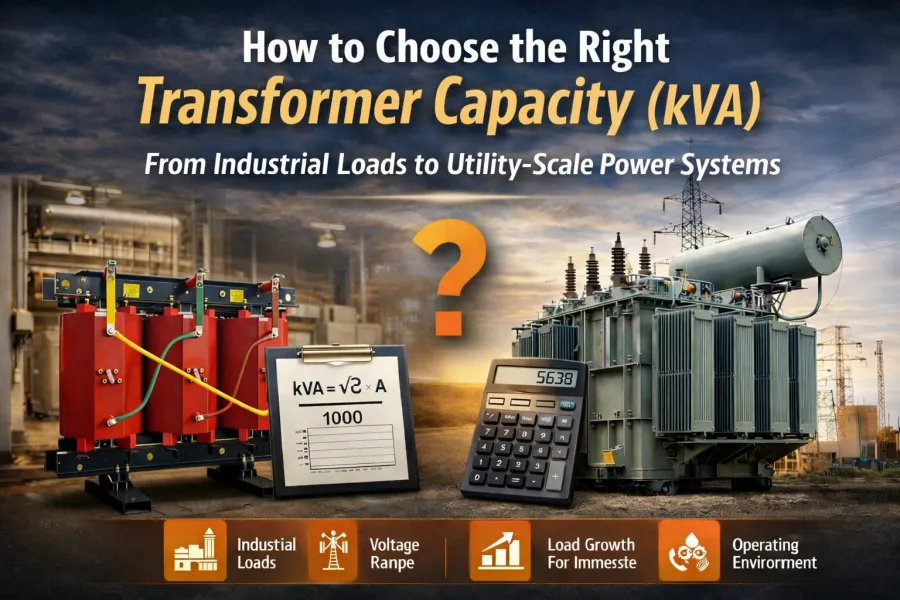
Selecting the correct transformer capacity (kVA) is one of the most critical steps in designing a safe, efficient, and reliable power distribution system. An undersized transformer can lead to overheating and reduced service life, while an oversized unit increases cost and operating losses.
This guide explains how to properly select transformer kVA ratings for industrial, commercial, and utility applications, covering load calculation, voltage levels, application scenarios, and common capacity ranges from 1 kVA to 40,000 kVA.
Understanding Transformer Capacity (kVA)
Transformer capacity is rated in kilovolt-amperes (kVA), which represents the apparent power a transformer can safely deliver under rated conditions.
Unlike kilowatts (kW), kVA accounts for both real power and reactive power, making it the standard unit for transformer sizing.
Basic formula:
-
Single-phase:
kVA = (Voltage × Current) ÷ 1000 -
Three-phase:
kVA = (√3 × Voltage × Current) ÷ 1000
Correct kVA selection ensures stable voltage, efficient operation, and long-term reliability.
Typical Transformer Capacity Ranges by Application
Small Capacity Transformers (1 kVA – 50 kVA)
Used primarily for control circuits and light loads.
Applications include:
-
Control panels and automation systems
-
Instrumentation and control power
-
Small machinery and laboratory equipment
These transformers are often dry type or isolation transformers, operating at 110V–480V.
Medium Capacity Transformers (75 kVA – 1000 kVA)
The most common range for industrial and commercial facilities.
Applications include:
-
Manufacturing production lines
-
Commercial buildings and offices
-
HVAC systems and motor loads
-
Small renewable energy installations
Typical configurations include dry type transformers, distribution transformers, and voltage regulators, operating at 380V, 400V, 415V, or 480V.
Large Industrial Transformers (1250 kVA – 5000 kVA)
Designed for continuous operation and higher load density.
Applications include:
-
Heavy industrial plants
-
Water treatment facilities
-
Mining and oil & gas sites
-
Large motor-driven systems
These systems often use oil-immersed transformers with primary voltages from 6kV to 35kV.
Utility & Infrastructure Transformers (5,000 kVA – 40,000 kVA)
High-capacity transformers used in power distribution and substation environments.
Applications include:
-
Utility substations
-
Renewable energy step-up substations
-
Grid interconnection projects
-
Large EPC infrastructure developments
These transformers are typically oil-immersed power transformers, rated up to 40,000 kVA, designed for 110V–35kV systems and continuous duty cycles.
Key Factors in Transformer Capacity Selection
1. Load Characteristics
Identify whether the load is:
-
Resistive (heaters, lighting)
-
Inductive (motors, pumps)
-
Non-linear (VFDs, rectifiers)
Motor-driven and non-linear loads require additional capacity margin.
2. Voltage Level & System Configuration
Transformer capacity must match:
-
Primary voltage (e.g. 10kV, 11kV, 33kV)
-
Secondary voltage (e.g. 400V, 480V)
-
Single-phase or three-phase systems
Incorrect voltage selection can reduce efficiency and damage equipment.
3. Load Growth & Future Expansion
Industry best practice recommends:
-
15–30% spare capacity for future load expansion
-
Higher margin for facilities with planned upgrades
4. Duty Cycle & Operating Environment
Continuous-duty applications and harsh environments require:
-
Higher thermal design margins
-
Oil-immersed transformers for better heat dissipation
Indoor, fire-sensitive areas may favor dry type transformers.
Dry Type vs Oil-Immersed Transformers: Capacity Considerations
| Factor | Dry Type Transformer | Oil-Immersed Transformer |
|---|---|---|
| Typical Capacity | 1–3000 kVA | 10–40,000 kVA |
| Voltage Range | Up to 35kV | Up to 35kV |
| Installation | Indoor | Outdoor / Substation |
| Cooling | Air (AN / AF) | Oil (ONAN / ONAF / OFAF) |
| Maintenance | Low | Periodic oil checks |
Choosing the correct transformer type is closely linked to required capacity and installation conditions.
Integrated Equipment That Affects Transformer Sizing
Transformer capacity selection should consider associated equipment, including:
-
Motor Control Centers (MCC)
These systems influence load profile, harmonics, and peak demand.
Work with a Professional Transformer Manufacturer
Accurate transformer sizing requires experience, engineering calculation, and application knowledge.
A professional manufacturer with in-house engineering and factory-controlled production can provide:
-
Capacity and voltage optimization
-
Customized transformer design
-
IEC / ANSI / IEEE / UL / CE compliant solutions
-
Factory testing and quality assurance
Conclusion: Choosing the Right kVA Rating
From 1 kVA control transformers to 40,000 kVA utility-scale power transformers, selecting the correct capacity ensures efficiency, safety, and long-term performance.
Understanding load characteristics, voltage requirements, and application environment is essential for reliable power system design.
Discuss Your Transformer Capacity Requirements
Whether you are planning a new project or upgrading an existing power system, professional guidance makes the difference.
Contact PowerNex to discuss your transformer capacity, voltage range (110V–35kV), and application requirements, and receive a customized power solution engineered for your project.