

PowerNex Transformer – Comprehensive Electrical & Transformer Glossary
This glossary provides a deep-dive into the technical terms used in the design, testing, manufacturing, and application of transformers, Automatic Voltage Regulators (AVR), Variable Frequency Drives (VFD), and power distribution systems. It is an essential resource for engineers, project managers, and procurement specialists.
A
-
Active Power (P): The actual power consumed by a load to perform work, measured in Watts (W) or Kilowatts (kW).
-
Air Cooling (AN): A cooling method where heat is dissipated by natural air convection without fans.
-
Air Core Transformer: A transformer without a magnetic core, used primarily in high-frequency applications.
-
Alternating Current (AC): Electric current that periodically reverses direction, the standard for global power grids.
-
Aluminum Winding: Transformer coils made of aluminum; offers a lightweight and cost-effective alternative to copper.
-
Ambient Temperature: The temperature of the air surrounding the transformer, crucial for determining thermal limits.
-
Amorphous Metal Core: A high-efficiency transformer core made from non-crystalline metal, significantly reducing no-load losses.
-
ANSI Standard: Specifications set by the American National Standards Institute for North American markets.
-
Apparent Power (S): The product of RMS voltage and current, measured in Volt-Amperes (VA) or kVA.
-
Arcing: A visible electrical discharge between two conductors through an insulating medium like air.
-
Autotransformer: A transformer with a single winding that acts as both primary and secondary, offering higher efficiency for small voltage ratios.
-
Automatic Voltage Regulator (AVR): A device that maintains a constant output voltage regardless of input fluctuations.
-
Auxiliary Transformer: A small transformer used to provide power to the internal auxiliary equipment of a substation or plant.
B
-
B-H Curve: A graphical representation showing the relationship between Magnetic Flux Density (B) and Magnetic Field Strength (H).
-
Balanced Load: A condition where the electrical load is distributed equally across all three phases of a system.
-
Basic Impulse Insulation Level (BIL): A reference insulation level expressed as the crest value of a standard lightning impulse voltage.
-
Breather: A device in oil-immersed transformers containing silica gel to remove moisture from the air entering the conservator.
-
Breakdown Voltage: The minimum voltage at which an insulator becomes electrically conductive.
-
Buchholz Relay: A safety device installed on oil-filled transformers to detect gas generation or oil surge caused by internal faults.
-
Busbar: A metallic strip or bar used to conduct substantial electrical current within a switchgear or transformer assembly.
-
Bushings: Insulated structures that allow a conductor to pass through a grounded transformer tank.
C
-
Capacity: The rated power handling capability of a transformer, usually expressed in kVA or MVA.
-
Capacitive Reactance: The opposition to AC flow due to capacitance, which leads to current leading voltage.
-
Cast Resin Transformer: A dry-type transformer where the windings are encapsulated in epoxy resin under vacuum.
-
CE Certification: A mark indicating compliance with European Union health, safety, and environmental protection standards.
-
Center Tap: A connection point made at the midpoint of a transformer winding.
-
Circuit Breaker: An automated electrical switch designed to protect a circuit from damage caused by excess current.
-
Class F Insulation: Materials rated for a maximum operating temperature of 155°C.
-
Class H Insulation: Materials rated for a maximum operating temperature of 180°C.
-
Conservator Tank: A small tank above the main transformer tank that allows for oil expansion and contraction.
-
Continuous Rating: The maximum constant load a transformer can carry without exceeding temperature limits.
-
Copper Loss: Heat generated by the resistance of the transformer windings ($I^2R$ loss).
-
Copper Winding: Transformer coils made of high-conductivity copper for maximum efficiency.
-
Core Loss: The power dissipated by the magnetic core due to hysteresis and eddy currents.
-
Current Transformer (CT): An instrument transformer used to step down high currents for measurement and protection.
D
-
Damping: The dissipation of energy to suppress oscillations in an electrical circuit.
-
Data Center Transformer: A transformer optimized for high harmonic loads and high reliability required by IT infrastructure.
-
DC Resistance: The resistance of the winding measured with direct current to check for loose connections or broken strands.
-
Delta Connection (Δ): A three-phase connection where the windings are connected end-to-end to form a closed loop.
-
Derating: The intentional reduction of the rated power of a device due to environmental factors like high altitude or temperature.
-
Dielectric Strength: The maximum electric field that a material can withstand without undergoing electrical breakdown.
-
Dissolved Gas Analysis (DGA): A diagnostic technique for oil-filled transformers to detect internal faults by measuring gases in the oil.
-
Distribution Transformer: A transformer used to step down voltage from the utility level to a level suitable for end-users.
-
Dry-Type Transformer: A transformer that uses air or solid insulation rather than liquid for cooling and insulation.
-
Dual Voltage: A transformer design that allows for two different input or output voltage settings.
E
-
Earth Grounding: A safety connection to the earth to provide a path for fault currents.
-
Eddy Current: Circular currents induced within the magnetic core that cause heating and power loss.
-
Efficiency: The ratio of output power to input power, typically exceeding 98% in high-quality transformers.
-
Electric Power Transformer: A high-capacity transformer used in transmission networks.
-
Electromagnetic Induction: The production of an electromotive force across a conductor in a changing magnetic field.
-
Electrostatic Shield: A grounded copper foil between primary and secondary windings to reduce electrical noise.
-
Encapsulated Winding: Windings sealed in a protective resin or compound for harsh environments.
-
Enclosure: The protective housing (IP or NEMA rated) surrounding the transformer.
-
Epoxy Resin: A thermosetting polymer used as an insulating and structural material in dry-type transformers.
-
Excitation Current: The current drawn by the primary winding when the secondary is open-circuit.
F
-
Factory Acceptance Test (FAT): A series of tests conducted at the manufacturer’s facility to verify performance before shipping.
-
Fault Current: The exceptionally high current that flows through a system during an electrical short circuit.
-
Ferroresonance: A non-linear resonance involving inductance and capacitance that can cause dangerous overvoltages.
-
Flux Density: The amount of magnetic flux per unit area, measured in Teslas (T).
-
Forced Air Cooling (AF): A cooling system that uses fans to increase the airflow over the windings and core.
-
Frequency (Hz): The number of cycles per second in an AC sine wave, typically 50Hz or 60Hz.
-
Full Load: The state in which a transformer is operating at its maximum rated capacity.
G
-
Galvanic Isolation: The physical and electrical separation of two circuits so that no direct current can flow between them.
-
Gapped Core: A magnetic core with a small air gap to prevent magnetic saturation.
-
GB Standard: The national standards of the People’s Republic of China for electrical equipment.
-
Generator Transformer: A transformer that steps up the voltage from a generator to the transmission grid level.
-
Global Voltage Standard: Common regional voltages such as 110V, 220V, 380V, 400V, 415V, 480V, and 690V.
-
Grain-Oriented Silicon Steel (CRGO): Specialized steel used in cores to provide a low-loss path for magnetic flux.
-
Ground Fault: An unintended connection between an energized conductor and the ground.
H
-
Harmonics: Frequencies that are integer multiples of the fundamental power frequency, caused by non-linear loads.
-
Hertz (Hz): The unit of frequency.
-
High Altitude Transformer: A transformer designed with increased insulation and cooling to operate in thin air above 1000m.
-
High Pot Test: A high-voltage dielectric test to verify the integrity of the insulation.
-
High Voltage (HV): Voltage levels typically ranging from 11kV to 36kV and above.
-
Hot Spot: The point of highest temperature within the transformer windings.
-
Hysteresis Loss: Energy loss in the core caused by the constant realignment of magnetic domains.
I
-
IEC Standard: Standards developed by the International Electrotechnical Commission, used globally.
-
IEEE Standard: Standards developed by the Institute of Electrical and Electronics Engineers.
-
Impedance (Z): The total opposition to AC flow, combining resistance and reactance.
-
Impedance Voltage: The voltage required to circulate rated current through a short-circuited winding.
-
Indoor Transformer: A transformer designed for installation inside a building, typically with an IP20 or IP21 rating.
-
Inrush Current: The transient peak current drawn when a transformer is first energized.
-
Insulation Class: A classification based on the maximum temperature the insulation can withstand (e.g., Class F, H).
-
Instrument Transformer: A general term for CTs and PTs used for monitoring and protection.
-
Interlayer Insulation: Insulation placed between the layers of a winding.
-
IP Rating: Ingress Protection rating, defining the enclosure’s protection against solids and liquids.
-
Isolation Transformer: A transformer used to decouple two circuits to prevent noise or electrical shock.
J–K
-
Joule Heating: The process by which the passage of an electric current through a conductor produces heat.
-
K-Factor: A rating used to describe a transformer’s ability to handle harmonic currents without overheating.
-
kVA (Kilovolt-Ampere): The standard unit for rating transformer capacity (Apparent Power).
-
kW (Kilowatt): The unit for Real Power.
L
-
Lamination: Thin sheets of silicon steel stacked together to form the transformer core, reducing eddy current losses.
-
Leakage Flux: Magnetic flux that does not follow the intended path through the core, contributing to leakage reactance.
-
Lightning Impulse Test: A test that simulates a lightning strike to check insulation durability.
-
Line-to-Line Voltage: The voltage measured between any two phases in a polyphase system.
-
Line-to-Neutral Voltage: The voltage measured between one phase and the neutral point.
-
Load Loss: Losses that occur when the transformer is under load, primarily due to winding resistance.
-
Low Voltage (LV): Voltages typically below 1000V (e.g., 400V, 480V, 600V).
M
-
Magnetic Flux: The total magnetic field passing through the transformer core.
-
Magnetizing Current: The component of the no-load current required to create the magnetic field in the core.
-
Marine Transformer: A transformer specifically built for ships/offshore platforms, featuring anti-corrosion and vibration resistance.
-
Medium Voltage (MV): Voltages between 1kV and 36kV.
-
Mining Transformer: A rugged, often flameproof transformer designed for use in underground mines.
-
Moisture Content: The amount of water present in transformer oil, which can significantly lower dielectric strength.
-
MVA (Megavolt-Ampere): A unit of power equal to 1,000 kVA.
N
-
Nameplate: A plate attached to the transformer stating its ratings, impedance, and connection diagram.
-
Natural Oil Cooling (ONAN): Cooling using the natural convection of oil and air.
-
Neutral: The common point in a star (Y) connection, which can be grounded.
-
Neutral Grounding Resistor (NGR): A resistor used to limit the fault current during a single-phase-to-ground fault.
-
No-Load Current: The current drawn by a transformer when the secondary is disconnected.
-
No-Load Loss: Power consumed by the transformer core when energized but not supplying power (Iron Loss).
-
Non-Linear Load: A load where the current waveform does not follow the voltage waveform (e.g., VFDs, computers).
O
-
Off-Circuit Tap Changer (OCTC): A tap changer that must be operated only when the transformer is de-energized.
-
Oil-Immersed Transformer: A transformer where the core and windings are submerged in insulating oil.
-
ONAF Cooling: Oil Natural Air Forced cooling, where fans are added to radiators to improve heat dissipation.
-
On-Load Tap Changer (OLTC): A tap changer that can adjust the voltage ratio while the transformer is under load.
-
Outdoor Transformer: A transformer designed for outdoor use, typically with a high IP rating (IP54/IP65) and UV protection.
-
Overload Capacity: The ability of a transformer to operate above its rated kVA for a specified duration.
P
-
Pad-Mounted Transformer: A ground-mounted transformer in a locked steel cabinet, used for underground power distribution.
-
Parallel Operation: Connecting two or more transformers to the same source and load to increase capacity.
-
Partial Discharge: A localized electrical discharge that only partially bridges the insulation between conductors.
-
Phase: A single conductor or winding in an AC system; most industrial systems are Three-Phase.
-
Phase Shifting Transformer: A specialized transformer used to control the flow of real power on a transmission grid.
-
Polarity: The relative direction of the induced voltages in the primary and secondary windings.
-
Pole-Mounted Transformer: A distribution transformer installed on a utility pole.
-
Power Factor: The ratio of real power (kW) to apparent power (kVA).
-
Primary Winding: The winding that is connected to the input power source.
Q–R
-
Rated Voltage: The voltage at which the transformer is designed to operate.
-
Reactive Power (Q): Power that oscillates between the source and the load without being consumed, measured in VAR.
-
Rectifier: An electrical device that converts AC to DC.
-
Regulation: The change in secondary voltage when the load is reduced from rated value to zero.
-
Renewable Energy Transformer: Transformers tailored for solar, wind, or battery storage applications.
-
Resistance: The opposition to the flow of electric current.
-
RMS Value: Root Mean Square value, the effective value of an AC current or voltage.
S
-
Saturation: The state where an increase in magnetic field strength no longer increases magnetic flux density.
-
Secondary Winding: The winding that delivers power to the load.
-
Servo Voltage Stabilizer: A high-precision voltage regulator that uses a servo motor to adjust the position of a carbon brush.
-
Short Circuit Test: A test performed to determine the transformer’s impedance and load losses.
-
Silicon Steel Core: The magnetic core of a transformer, made of steel alloyed with silicon to reduce losses.
-
Solar Transformer: A step-up transformer used in photovoltaic plants to connect inverters to the grid.
-
Space Heater: An internal heater used to prevent condensation inside the transformer enclosure.
-
Static Voltage Regulator: A solid-state regulator that uses thyristors or IGBTs for ultra-fast voltage correction.
-
Step-Down Transformer: A transformer where the output voltage is lower than the input voltage.
-
Step-Up Transformer: A transformer where the output voltage is higher than the input voltage.
-
Surge Protection: Devices like lightning arresters that protect the transformer from transient overvoltages.
T
-
Tap Changer: A mechanism that allows the winding ratio to be changed to regulate output voltage.
-
Temperature Rise: The increase in temperature of the windings or oil over the ambient temperature during operation.
-
Terminal: A point of connection for external electrical circuits.
-
Three-Phase System: A common method of AC power generation and transmission using three wires.
-
Toroidal Transformer: A transformer with a ring-shaped core, known for low electromagnetic interference and high efficiency.
-
Total Harmonic Distortion (THD): A measurement of the harmonic distortion present in a signal.
-
Transformation Ratio: The ratio of the number of turns in the primary winding to the number of turns in the secondary.
-
Transformer Oil: A highly refined mineral or synthetic oil used for insulation and cooling.
U
-
UL Listed: A certification from Underwriters Laboratories indicating the product meets specific safety standards.
-
Unbalanced Load: When the current or phase voltage in a three-phase system is not equal.
-
Under-Voltage: A condition where the voltage drops below the intended operating range.
-
Unit Substation: A complete assembly including a transformer and high/low voltage switchgear.
V
-
Vacuum Pressure Impregnation (VPI): A process used for dry-type transformers to ensure deep penetration of varnish into the coils.
-
Variable Frequency Drive (VFD): A device that controls the speed of an AC motor by varying the frequency of the power supply.
-
Vector Group: A shorthand notation (e.g., Dyn11) for the connection and phase displacement of three-phase transformers.
-
Volt (V): The unit of electromotive force or potential difference.
-
Voltage Drop: The reduction in voltage as it passes through a conductor or transformer due to impedance.
-
Voltage Regulation: The ability of a system to provide a near-constant voltage under varying load conditions.
W–Z
-
Watt (W): The unit of real power.
-
Waveform: The shape of a signal, such as a sine wave or square wave.
-
Winding: A set of turns of insulated wire forming an electrical circuit within the transformer.
-
Winding Resistance Test: A test to ensure the integrity of the coils and internal connections.
-
Wye Connection (Star): A three-phase connection where one end of each phase is connected to a common neutral point.
-
X (Reactance): The imaginary part of impedance, caused by inductance or capacitance.
-
Yoke: The part of the magnetic core that connects the limbs (posts) together.
-
Zero Sequence Current: Current that flows in a system during a ground fault.
-
Zig-zag Connection: A special winding connection used to create a neutral point or to ground a delta system.
PowerNex Transformer – Your Partner in Electrical Excellence
Need a specific technical specification or a custom transformer quote? Our engineering team is ready to assist you with global projects.
Latest News
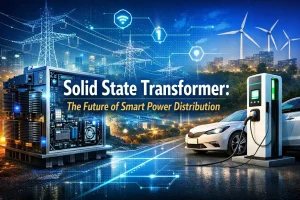
The Future of Power Distribution: Solid State Transformers (SST)
Introduction The Solid State Transformer (SST) is rapidly emerging as a breakthrough technology in modern [...]
Mar
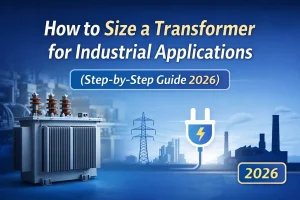
How to Size a Transformer for Industrial Applications in 2026 (Complete Step-by-Step Guide)
Introduction Choosing the correct transformer size for an industrial application is one of the most [...]
Mar
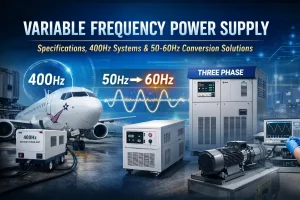
Variable Frequency Power Supply: Industrial Guide to Specifications, Applications, 400Hz Systems & Frequency Conversion Solutions
A Variable Frequency Power Supply (VFPS) is a programmable AC power source designed to convert [...]
Feb
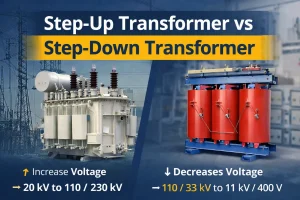
Step-Up Transformer vs Step-Down Transformer: Key Differences, Applications, and How to Choose the Right Power Solution
In modern power systems, transformers play a critical role in voltage conversion to ensure safe, [...]
Feb