

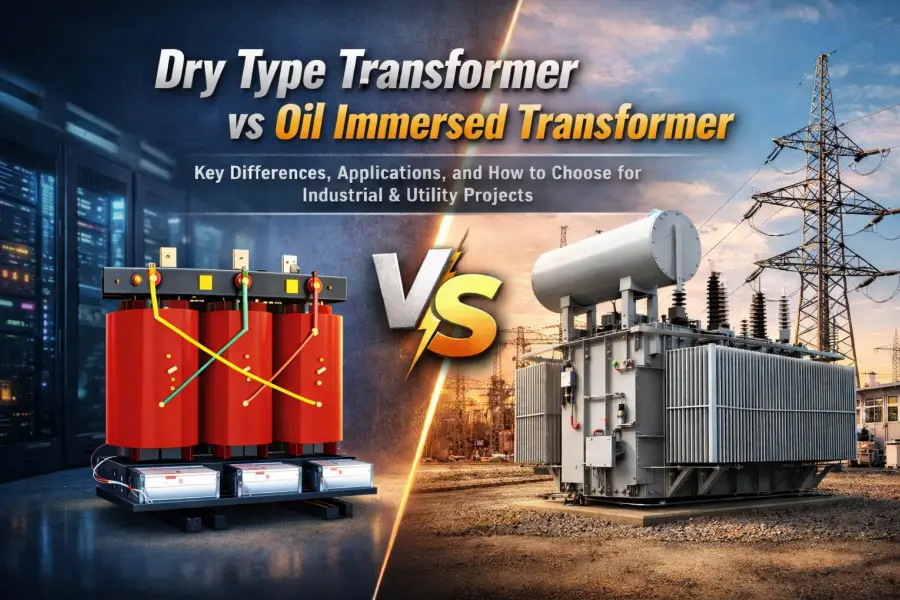
Introduction
Choosing the right transformer is a critical decision for industrial plants, commercial buildings, renewable energy projects, and utility power systems. Among all options, dry type transformers and oil immersed transformers are the two most commonly specified solutions worldwide.
However, many EPC contractors, electrical engineers, and procurement managers still ask the same question:
Dry type transformer vs oil immersed transformer – which one is better for my project?
The answer depends on safety requirements, installation environment, load characteristics, lifecycle cost, and local standards. This guide provides a clear, side-by-side comparison to help B2B buyers make confident, cost-effective decisions.
What Is a Dry Type Transformer
A dry type transformer uses air as the cooling medium and solid insulation materials such as epoxy resin or vacuum pressure impregnation (VPI). There is no insulating oil, making it a safer choice for indoor and fire-sensitive environments.
Key characteristics:
-
No oil, no leakage risk
-
Air-cooled (AN or AF)
-
Lower fire and explosion hazard
-
Commonly installed indoors
-
Meets IEC, IEEE, ANSI standards
Dry type transformers are widely used in commercial buildings, data centers, hospitals, factories, and renewable energy systems.
What Is an Oil Immersed Transformer
An oil immersed transformer uses mineral oil or ester oil for insulation and cooling. The oil improves heat dissipation and allows higher power ratings and better overload capability.
Key characteristics:
-
Oil-filled for insulation and cooling
-
Higher efficiency at large capacities
-
Better short-term overload performance
-
Suitable for outdoor and utility installations
-
Long service life under stable conditions
Oil immersed transformers dominate utility substations, power generation plants, transmission & distribution networks, and heavy industrial applications.
Dry Type Transformer vs Oil Immersed Transformer: Key Differences
Cooling and Insulation
Dry type transformers rely on air cooling, while oil immersed transformers use insulating oil. Oil cooling allows higher efficiency and larger capacity, but introduces fire and environmental considerations.
Safety and Fire Risk
Dry type transformers offer higher fire safety, making them ideal for indoor and populated areas. Oil immersed transformers require fire protection systems and oil containment measures, especially indoors.
Installation Environment
Dry type transformers are best for indoor installations with limited space. Oil immersed transformers are commonly installed outdoors or in dedicated substations.
Capacity Range
Dry type transformers are typically used up to 5–10 MVA, while oil immersed transformers can easily exceed 100 MVA, making them essential for utility-scale projects.
Maintenance Requirements
Dry type transformers require minimal maintenance. Oil immersed transformers need regular oil testing, filtration, and monitoring to maintain performance.
Cost Consideration
Initial cost of dry type transformers is usually higher for the same rating, but oil immersed transformers offer lower cost per kVA at medium and large capacities.
Learn More:Isolation Transformer vs Control Transformer for European Industry
Typical Applications Comparison
Dry Type Transformer Applications
-
Commercial buildings
-
Data centers and IT infrastructure
-
Hospitals and schools
-
Industrial plants with indoor substations
-
Solar and wind inverter stations
Oil Immersed Transformer Applications
-
Utility substations
-
Power generation plants
-
Transmission and distribution networks
-
Heavy industries (steel, mining, oil & gas)
-
Large renewable energy projects
Which Transformer Is More Efficient
From an efficiency standpoint:
-
Oil immersed transformers generally achieve higher efficiency at medium to large ratings due to superior cooling.
-
Dry type transformers are highly efficient at small to medium loads, especially when energy efficiency standards (DOE, EcoDesign) are applied.
For B2B buyers, total cost of ownership (TCO) is more important than nameplate efficiency alone.
How to Choose the Right Transformer for Your Project
When selecting between dry type and oil immersed transformers, consider the following factors:
-
Installation location: indoor or outdoor
-
Fire safety regulations: building codes, insurance requirements
-
Power rating and load profile
-
Maintenance capability
-
Environmental conditions
-
Budget and lifecycle cost
For indoor, fire-sensitive, and low-maintenance projects, dry type transformers are often the best choice.
For outdoor, high-capacity, and utility-scale systems, oil immersed transformers remain the industry standard.
Why Global EPCs and Utilities Choose PowerNex Transformers
At PowerNex, we manufacture both dry type transformers and oil immersed transformers to meet global standards including IEC, IEEE, ANSI, and CSA.
Our advantages for B2B customers include:
-
Factory-direct pricing
-
Custom voltage and power ratings
-
Proven performance in industrial and utility projects
-
Support for North America, Europe, Australia, and Latin America
-
Fast engineering response for EPC and OEM clients
Whether you need a compact indoor dry type transformer or a high-capacity oil immersed transformer for a substation, PowerNex delivers reliable power solutions tailored to your project.
Conclusion
By understanding the differeThere is no one-size-fits-all answer in the debate between dry type transformers and oil immersed transformers. The right choice depends on application, safety, capacity, and long-term cost.nces and aligning them with your project requirements, you can ensure safe operation, optimized performance, and long-term reliability.
For expert guidance and customized transformer solutions, PowerNex is your trusted manufacturing partner.