

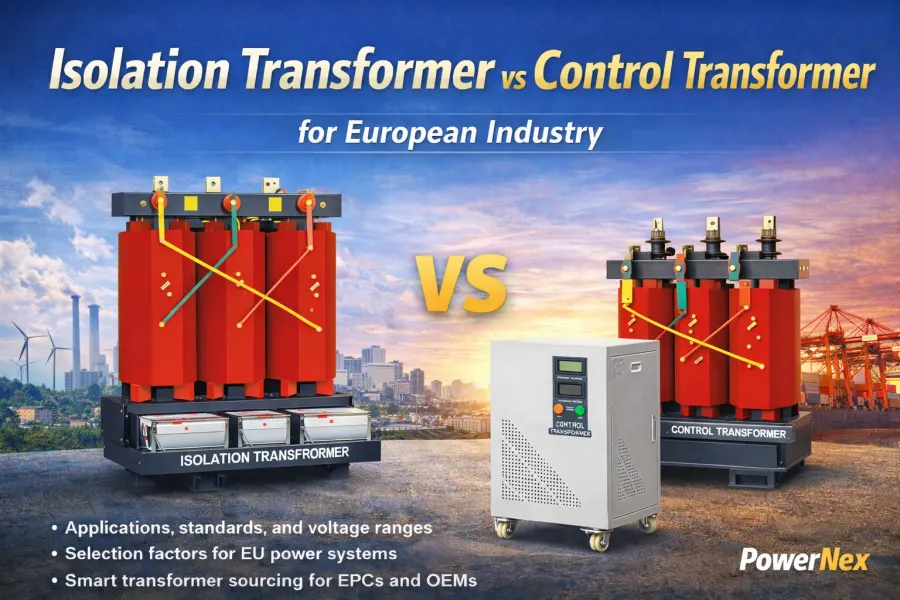
Introduction: Why This Comparison Matters in European Industrial Systems
In European industrial environments, transformers are not just about voltage conversion—they are critical components for safety, system stability, and compliance with strict IEC and EN standards. Among the most commonly specified types in industrial automation, machinery manufacturing, and control systems are isolation transformers and control transformers.
Although these two transformer types are often mentioned together, they serve very different purposes. Misunderstanding their roles can lead to overspending, non-compliant designs, or even operational risks. This guide explains the key differences, applications, and selection criteria for isolation transformers and control transformers in European industry, helping EPC contractors, OEMs, and industrial buyers make informed decisions.
What Is an Isolation Transformer?
An isolation transformer is designed to electrically isolate the primary and secondary circuits while maintaining the same or similar voltage level. Its core function is galvanic isolation, which improves safety and reduces electrical noise.
In European industrial applications, isolation transformers are widely used to:
-
Protect personnel from electric shock
-
Reduce ground loop issues
-
Suppress electrical noise and harmonics
-
Improve system reliability in sensitive equipment
Typical capacity ranges for industrial isolation transformers are 5 kVA to 5000 kVA, with voltage configurations covering low voltage up to medium voltage systems (up to 35 kV), depending on the application.
What Is a Control Transformer?
A control transformer is primarily used to supply stable, low-voltage power to control circuits, such as PLCs, relays, sensors, contactors, and industrial automation panels. Unlike isolation transformers, control transformers focus on voltage stability under fluctuating load conditions.
In European factories, control transformers are commonly applied in:
-
Machine tool control panels
-
Production lines and automation systems
-
Motor control centers (MCCs)
-
Packaging, CNC, and robotic equipment
Control transformers usually operate in lower capacity ranges, typically 50 VA to 25 kVA, with secondary voltages such as 24 V, 48 V, 110 V, and 230 V, fully aligned with European control standards.
Key Differences Between Isolation Transformers and Control Transformers
While both transformer types may appear similar in construction, their design priorities are fundamentally different.
Isolation transformers prioritize:
-
Electrical separation between primary and secondary
-
Enhanced insulation systems
-
Reduced leakage current
-
Compliance with safety-driven applications
Control transformers prioritize:
-
Voltage regulation under inrush conditions
-
Compact size for panel mounting
-
Continuous duty performance
-
Stable output for sensitive control components
Choosing the wrong type can result in unnecessary cost or insufficient protection.
Capacity and Voltage Selection for European Industry
Capacity and voltage selection is one of the most critical decision points for both transformer types.
For isolation transformers, common European industrial configurations include:
-
Capacity: 10 kVA, 50 kVA, 100 kVA, 250 kVA, 500 kVA, up to 5000 kVA
-
Primary voltage: 400 V, 690 V, 6 kV, 10 kV, 11 kV, 20 kV
-
Secondary voltage: matched or stepped-down depending on system design
For control transformers, typical configurations include:
-
Capacity: 100 VA, 500 VA, 1 kVA, 5 kVA, 10 kVA
-
Primary voltage: 400 V or 230 V
-
Secondary voltage: 24 V, 48 V, 110 V, or 230 V
Correct sizing ensures efficiency, thermal stability, and long service life.
IEC and EN Standards in Europe
European industrial projects are governed by strict regulatory frameworks. Both isolation transformers and control transformers must comply with applicable standards, including:
-
IEC 60076 for power and industrial transformers
-
IEC 61558 for safety isolating and control transformers
-
EN standards aligned with CE marking requirements
Compliance is not optional. European EPC contractors and OEMs must ensure that transformers meet insulation class, temperature rise, and safety isolation requirements before installation.
When to Choose an Isolation Transformer
An isolation transformer is the right choice when:
-
Electrical safety and personnel protection are priorities
-
Sensitive equipment requires noise suppression
-
Ground loop issues affect system performance
-
Medium voltage or higher capacity isolation is required
Isolation transformers are commonly specified in data centers, medical facilities, industrial plants, and critical infrastructure projects across Europe.
When to Choose a Control Transformer
A control transformer is the better solution when:
-
Supplying power to control circuits only
-
Compact panel installation is required
-
Frequent switching or inrush currents are expected
-
Cost efficiency and simplicity are priorities
They are essential components in nearly every European industrial automation system.
Sourcing Isolation and Control Transformers for Europe
Many European buyers are increasingly sourcing isolation transformers and control transformers from experienced manufacturers outside Europe, including China. The reasons include:
-
Competitive factory-direct pricing
-
Flexible customization for voltage, capacity, and enclosure
-
Mature IEC-compliant manufacturing processes
-
Shorter lead times for non-standard designs
For European projects, selecting a supplier with proven export experience, strict quality control, and full technical documentation is critical.
Common Buyer Mistakes to Avoid
Some frequent issues seen in European projects include:
-
Oversizing control transformers unnecessarily
-
Using control transformers where isolation is required
-
Ignoring temperature rise and duty cycle
-
Selecting non-compliant designs without IEC certification
Avoiding these mistakes reduces operational risk and total project cost.
Final Thoughts: Making the Right Choice
Isolation transformers and control transformers are both indispensable in European industrial systems—but they are not interchangeable. Understanding their differences in function, capacity, voltage, and compliance requirements allows engineers and procurement teams to design safer, more reliable, and more cost-effective power systems.
By aligning transformer selection with real application needs and sourcing from qualified manufacturers that understand European standards, industrial buyers can achieve long-term performance and compliance without unnecessary expense. PowerNex