

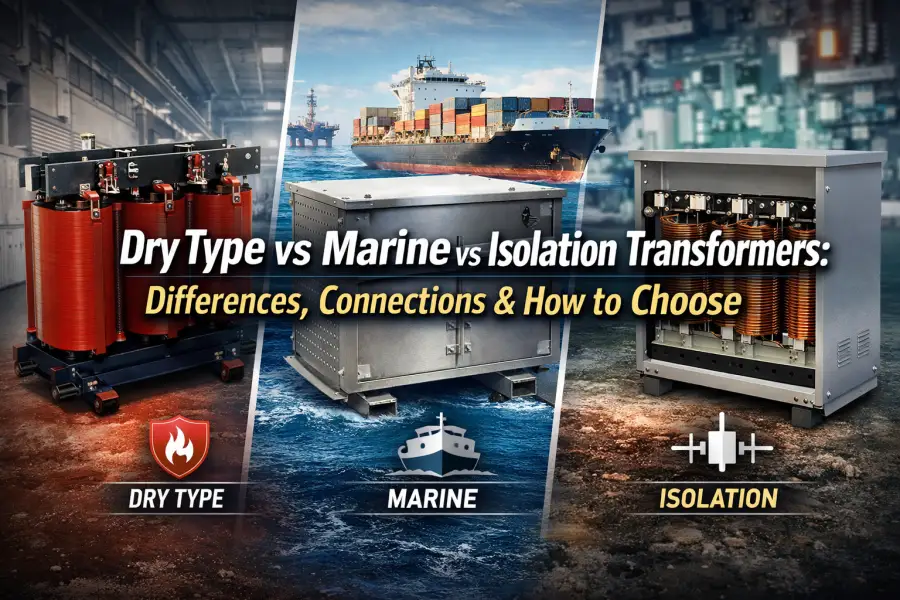
Introduction: Why Transformer Selection Matters
Choosing the right transformer is a critical decision for industrial, commercial, and marine electrical systems. Many buyers searching online encounter terms such as dry type transformer, marine transformer, and isolation transformer, often wondering how these transformers are related, how they differ, and which one is best suited for their application.
This guide is written for global buyers, engineers, EPC contractors, shipbuilders, and industrial procurement teams. It explains the relationship between dry type transformers, marine transformers, and isolation transformers, and provides clear guidance on how to select the right transformer for your project.
If you are searching for safe, reliable, and certified transformer solutions, this article will help you make an informed decision.
What Is a Dry Type Transformer?
A dry type transformer is a transformer that uses air and solid insulation systems instead of insulating oil for cooling and insulation. Unlike oil-filled transformers, dry type transformers do not contain flammable liquids, making them safer and more environmentally friendly.
Key Characteristics of Dry Type Transformers
-
Oil-free design with air cooling
-
High fire safety and low environmental risk
-
Suitable for indoor installations
-
Low maintenance requirements
-
Commonly used in industrial and commercial power distribution
Dry type transformers are widely applied in factories, data centers, commercial buildings, hospitals, infrastructure projects, and utility distribution systems. They can be designed as standard power transformers or configured as isolation transformers depending on the application.
What Is a Marine Transformer?
A marine transformer is a transformer specifically designed for shipboard and offshore electrical systems. Marine transformers must operate reliably under harsh conditions such as vibration, humidity, salt mist, temperature variation, and limited installation space.
Key Characteristics of Marine Transformers
-
Designed for marine and offshore environments
-
Enhanced insulation and corrosion resistance
-
Compact structure and robust mechanical strength
-
Compliant with marine classification standards
Marine transformers can be dry type or oil-filled, but in modern vessels, dry type marine transformers are increasingly preferred due to fire safety and environmental requirements.
Typical applications include:
-
Cargo ships and tankers
-
Offshore platforms
-
Cruise ships and naval vessels
-
Port and shipyard electrical systems
What Is an Isolation Transformer?
An isolation transformer is designed to electrically isolate the input circuit from the output circuit. The primary purpose of an isolation transformer is safety, noise reduction, and protection of sensitive equipment.
Key Functions of Isolation Transformers
-
Electrical isolation between primary and secondary circuits
-
Reduction of electrical noise and interference
-
Protection against ground faults and voltage disturbances
-
Improved system reliability
Isolation transformers can be single-phase or three-phase, dry type or oil-filled, and are widely used in:
-
Control panels
-
Automation systems
-
Medical equipment
-
Data centers
-
Sensitive industrial loads
The Relationship Between Dry Type, Marine, and Isolation Transformers
Many buyers mistakenly assume that dry type transformers, marine transformers, and isolation transformers are completely different products. In reality, they are closely related concepts.
How They Are Connected
-
Dry type transformer refers to the cooling and insulation method
-
Marine transformer refers to the application environment
-
Isolation transformer refers to the electrical function
This means:
-
A marine transformer can be a dry type transformer
-
An isolation transformer can be a dry type transformer
-
A marine isolation transformer is often a dry type isolation transformer designed for shipboard use
Understanding this relationship helps buyers choose the right configuration rather than focusing only on the name.
Dry Type Transformer vs Marine Transformer vs Isolation Transformer
| Aspect | Dry Type Transformer | Marine Transformer | Isolation Transformer |
|---|---|---|---|
| Core Definition | Cooling & insulation method | Application-specific design | Electrical function |
| Oil-Free | Yes | Usually | Often |
| Fire Safety | High | High (marine-rated) | High |
| Environment | Industrial / Commercial | Marine / Offshore | Industrial / Sensitive loads |
| Custom Design | Yes | Yes | Yes |
How to Choose the Right Transformer for Your Application
Step 1: Define the Application Environment
-
Indoor factory or commercial building → Dry Type Transformer
-
Ship, offshore platform, or port facility → Marine Transformer
-
Sensitive equipment or control system → Isolation Transformer
Step 2: Determine Safety and Compliance Requirements
-
High fire safety → Dry type preferred
-
Marine classification needed → Marine transformer required
-
Electrical isolation required → Isolation transformer necessary
Step 3: Confirm Electrical Parameters
-
Voltage levels (primary and secondary)
-
Power rating (kVA)
-
Phase (single-phase or three-phase)
-
Frequency (50 Hz / 60 Hz)
Step 4: Consider Customization and Certifications
-
Insulation class (F or H)
-
Enclosure type and protection level
-
International standards (IEC, IEEE, ANSI)
-
Certifications (CE, UL, marine class approvals)
Choosing a manufacturer that offers custom engineering and global certification support is critical for international projects.
Why Dry Type Isolation Transformers Are Gaining Popularity
In many modern applications, buyers are choosing dry type isolation transformers because they combine:
-
The safety of dry type design
-
The protection of electrical isolation
-
Low maintenance and long service life
These transformers are widely used in industrial automation, marine electrical systems, data centers, and critical infrastructure projects worldwide.
Common Buyer Questions (FAQ)
Is a marine transformer always oil-filled?
No. Many modern marine transformers are dry type to meet fire safety and environmental regulations.
Can a dry type transformer be used as an isolation transformer?
Yes. Dry type transformers can be designed as isolation transformers with separate windings.
Which transformer is safest for indoor industrial use?
A dry type transformer is generally the safest choice.
Final Thoughts: Choosing the Right Transformer Partner
Understanding the relationship between dry type transformers, marine transformers, and isolation transformers allows buyers to make better technical and commercial decisions. The key is not just selecting a transformer type, but choosing a reliable manufacturer that can provide customized solutions, global certifications, and long-term support.
If your project requires industrial power distribution, marine electrical systems, or electrical isolation solutions, working with an experienced transformer supplier can significantly reduce risk and total cost of ownership.
Ready to Select the Right Transformer?
If you are planning a project and need expert guidance on dry type transformers, marine transformers, or isolation transformers, our engineering team can help you select the most suitable solution and provide a competitive quotation.
Contact us today to discuss your application and receive a customized transformer solution.