

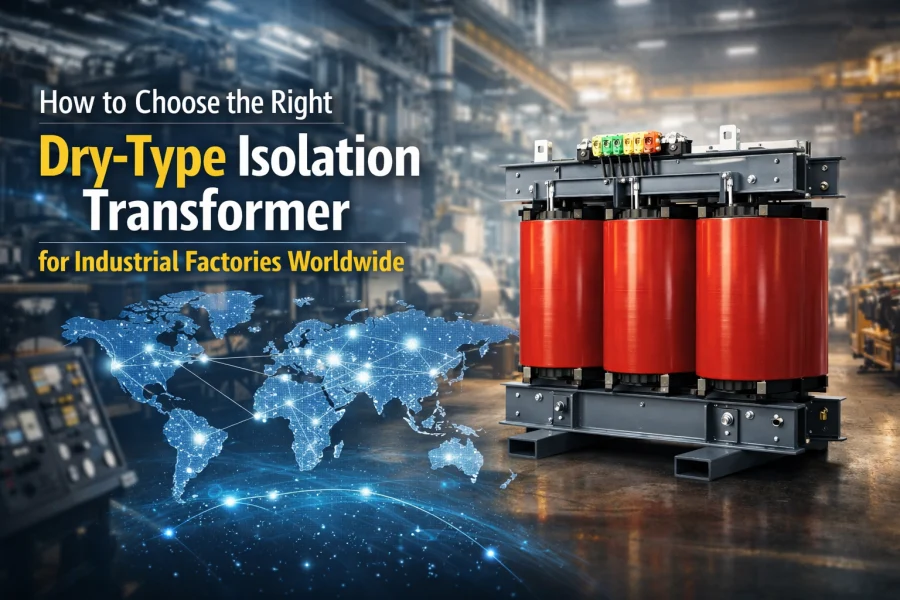
In modern industrial operations, a reliable and stable power supply is crucial for factories, manufacturing plants, workshops, and heavy machinery. One of the most effective solutions for ensuring equipment safety, voltage stability, and efficient power distribution is the dry-type isolation transformer. Selecting the right transformer for your facility can improve equipment lifespan, production efficiency, and operational safety. This guide provides industrial buyers and facility managers worldwide with a step-by-step approach to choosing the right dry-type isolation transformer, whether your factory requires 5 kVA, 15 kVA, 30 kVA, 35 kVA, 50 kVA, 75 kVA, 100 kVA, 112 kVA, or up to 500 kVA.
Why Dry-Type Isolation Transformers Are Essential for Industrial Facilities
Dry-type isolation transformers provide electrical isolation, voltage stabilization, and noise reduction, which are critical for industrial and commercial applications. Unlike oil-filled transformers, dry-type transformers use air as the cooling medium, making them fire-safe, low-maintenance, and environmentally friendly. For factories with CNC machines, heavy machinery, energy storage systems, or commercial electrical equipment, these transformers ensure stable power without risk of contamination or oil leakage.
Some key benefits include:
-
Electrical isolation: Protects sensitive equipment from voltage spikes and short circuits.
-
Stable voltage output: Reduces equipment downtime caused by fluctuating power.
-
Low maintenance: Oil-free design eliminates regular oil checks and replacements.
-
Safety: Non-flammable insulation reduces fire hazards, making them suitable for indoor use.
-
Global compatibility: Can be customized for multiple voltages, phases, and frequencies.
Step 1: Assess Your Factory’s Power Requirements
Before selecting a transformer, understand your facility’s total load, peak demand, and operational patterns. Consider:
-
The number of machines and production lines
-
Maximum power draw at peak operation
-
Critical equipment that requires uninterrupted power
Power rating is typically measured in kVA. Dry-type isolation transformers come in a wide range, from 5 kVA to 500 kVA, with popular industrial ratings including 15 kVA, 30 kVA, 35 kVA, 50 kVA, 75 kVA, 100 kVA, and 112 kVA. Choosing a transformer too small may cause overloading, while a transformer that is too large increases initial cost and energy loss.
Tip for B2B procurement: Calculate your total factory load plus 20–30% buffer for future expansion. This ensures the transformer can handle peak loads and potential production increases.
Step 2: Determine Voltage and Phase Requirements
Voltage and phase configuration are critical for equipment compatibility and operational efficiency. Typical options include:
-
Primary voltage: 220 V, 380 V, 400 V, 415 V, 440 V, 480 V
-
Secondary voltage: 220 V, 240 V, 380 V, 400 V, 440 V, 480 V
-
Phase: Single-phase or three-phase
-
Frequency: 50 Hz / 60 Hz
Factories with heavy machinery or energy storage systems often use three-phase transformers to ensure balanced load and stable power delivery. For smaller workshops or commercial facilities, single-phase transformers may be sufficient. Many manufacturers, including PowerNex, offer customized voltage and phase configurations to suit global industrial standards.
Step 3: Evaluate Transformer Efficiency and Energy Savings
Transformer efficiency has a direct impact on operating costs. High-efficiency transformers reduce energy losses and heat generation, lowering electricity bills and extending equipment life. Industrial-grade dry-type transformers typically achieve ≥98% efficiency at full load.
Benefits of high-efficiency transformers:
-
Reduced energy waste and operating expenses
-
Lower heat rise, minimizing risk to equipment
-
Compliance with international energy efficiency standards
For factories with multiple production lines or continuous operation, investing in high-efficiency dry-type transformers provides long-term cost savings.
Step 4: Cooling Methods and Maintenance
Dry-type transformers use air cooling, available as:
-
Natural Air (AN): Suitable for standard indoor applications; low maintenance
-
Forced Air (FA): Ideal for high-load or high-temperature environments; slightly higher cost
Advantages of dry-type cooling:
-
Oil-free design reduces fire and environmental risks
-
Minimal maintenance compared to oil-filled transformers
-
Stable operation even in continuous industrial use
Regular maintenance includes dust cleaning, checking connections, and monitoring temperature. Proper maintenance ensures long-term reliability and reduces the risk of unscheduled downtime.
Step 5: Compliance with Standards and Certifications
Global industrial facilities require transformers that meet international safety and performance standards. Key certifications include:
-
IEC 61558, IEC 60076, ISO 9001 – international electrical standards
-
CE certified – European safety compliance
-
UL, cUL, CSA – North American compliance
-
SGS or other third-party inspection for B2B verification
Using certified transformers ensures safety, legal compliance, and reliable operation across industrial sites worldwide.
Step 6: Consider Environmental and Installation Factors
When installing a dry-type isolation transformer, consider:
-
Enclosure type: NEMA 1 for indoor use, NEMA 3R for outdoor applications
-
Space and ventilation: Ensure adequate clearance for airflow and maintenance
-
Environmental conditions: Temperature, humidity, and vibration levels
-
Noise requirements: Dry-type transformers are low-noise, ideal for workshops or labs
Proper planning prevents premature wear, overheating, and operational issues, ensuring long-term performance.
Step 7: Applications Across Industries
Dry-type isolation transformers are used in a variety of industrial and commercial applications:
-
Factories and manufacturing plants: Production lines, CNC machines, presses, conveyors
-
Workshops: Voltage stabilization and machinery protection
-
Commercial buildings: Stable, isolated power for sensitive equipment
-
Laboratories and medical facilities: Low-noise, isolated power for diagnostic or production tools
-
Energy storage and renewable energy systems: Reliable step-up or step-down voltage solutions
By selecting the right transformer capacity and specifications, factories can improve productivity, reduce downtime, and protect critical assets.
Step 8: Customization Options for Industrial Needs
Leading manufacturers, including PowerNex, offer transformers with:
-
Custom voltage and phase configurations
-
Multi-tap secondary options
-
Specialized enclosures for indoor or outdoor use
-
Optional cooling upgrades for high-demand environments
-
Compliance with global certifications for B2B procurement
Customized solutions ensure transformers meet specific operational needs while supporting future expansion or technology upgrades.
Step 9: Common Selection Mistakes to Avoid
Many industrial buyers make mistakes when selecting transformers:
-
Choosing a transformer with insufficient kVA for peak load
-
Ignoring phase and voltage compatibility with existing equipment
-
Focusing only on initial cost rather than efficiency and lifecycle savings
-
Overlooking international certifications for global operations
-
Neglecting installation environment, such as temperature, ventilation, or noise restrictions
Avoiding these pitfalls ensures long-term reliability and safety while reducing operational costs.
Step 10: How to Make a B2B Inquiry
Once your factory determines capacity, voltage, phase, and customization needs, contact certified manufacturers or distributors for a quotation. Provide details such as:
-
Required kVA capacity (e.g., 35 kVA, 50 kVA, 75 kVA)
-
Primary and secondary voltages and phase
-
Installation environment (indoor/outdoor, ventilation, temperature)
-
Desired standards and certifications
-
Any special requirements for industrial, commercial, or energy storage applications
Manufacturers like PowerNex provide global shipping, B2B pricing, and technical support, ensuring industrial clients receive reliable, efficient, and certified transformers.
Conclusion
Selecting the right dry-type isolation transformer is essential for industrial factories, workshops, commercial buildings, and energy storage systems worldwide. Consider factors such as power rating, voltage, phase, efficiency, cooling, standards, installation environment, and application requirements. Transformers ranging from 5 kVA to 500 kVA, including the widely used 35 kVA, provide safe, stable, and high-efficiency power for all industrial operations.
With proper selection, factories can protect sensitive equipment, improve operational efficiency, and ensure long-term reliability. For B2B procurement and global supply, choosing certified and customizable transformers is key. Contact PowerNex today to discuss your industrial transformer needs, request a quote, and secure a high-performance, reliable solution for your facility.
Dry-type step-up transformer, industrial isolation transformer, high-efficiency voltage solution, heavy-duty power transformers for factories, workshops, manufacturing plants, and industrial equipment PowerNex