
FAQ 1
Q: What type of company is PowerNex Transformer, and what is your global market presence?
A: PowerNex Transformer is a professional manufacturer specializing in power transformers, distribution transformers, dry type transformers, isolation transformers, voltage regulators, VFDs, AVRs, marine transformers, and customized electrical solutions. We have extensive global experience serving Europe, North America, South America, Africa, Middle East, and Asia, supporting various electrical standards such as IEC, IEEE, ANSI, GB, and EN. Our customers include utility companies, industrial plants, renewable energy projects, commercial buildings, and marine applications. We provide standard and fully customized solutions, including engineering design, testing, manufacturing, and on-site technical support.
FAQ 2
Q: Are you a direct manufacturer or a trading company?
A: PowerNex Transformer is a direct manufacturer with its own factories, production lines, and engineering team. Unlike trading companies, we maintain full control over material selection, manufacturing quality, testing, and customization. This ensures competitive factory pricing, stable quality, and reliable technical support, allowing us to provide OEM and ODM solutions for global customers.
FAQ 3
Q: What is a Dry Type Transformer and where is it used?
A: A Dry Type Transformer uses air instead of oil for cooling and insulation, making it fire-safe, environmentally friendly, and low maintenance. Dry Type Transformers are widely used in commercial buildings, hospitals, data centers, airports, metro stations, and industrial facilities. They are suitable for indoor installation, can operate in ambient temperatures ranging from -40°C to +50°C, and are available in capacities from 50 kVA to 5000 kVA, with primary voltages from 3.3 kV to 13.8 kV, secondary voltages from 400V to 690V, and frequencies 50Hz/60Hz. Custom voltages, insulation classes, and enclosure IP ratings can also be provided for specific project requirements.
FAQ 4
Q: What are Distribution Transformers and what applications do they serve?
A: Distribution Transformers are used to step down medium voltage to low voltage, distributing electricity safely to residential areas, commercial facilities, industrial parks, and rural networks. They support primary voltages from 6.6kV to 33kV, secondary voltages 400V, 415V, 480V, 600V, or 230V, and capacities from 10 kVA to 2500 kVA. Customization options include tap changers, cooling methods (ONAN, ONAF), insulation materials, enclosures, and noise reduction. They are designed for global applications, including tropical, desert, high-altitude, and marine environments.
FAQ 5
Q: What is an Electric Power Transformer and what are its main uses?
A: Electric Power Transformers are high-capacity transformers used in power transmission, substations, and industrial grids. They step up or step down high voltages, typically up to 132 kV or more, with capacities ranging from 5 MVA to over 100 MVA. Applications include power plants, transmission networks, industrial heavy-load systems, and renewable energy projects. We design Power Transformers with low losses, high efficiency, long service life, and compliance with IEC, IEEE, ANSI, GB, and EN standards. Custom voltage ratios, tap changers, and cooling systems are available.
FAQ 6
Q: What is an Isolation Transformer and why is it important?
A: An Isolation Transformer electrically separates input and output circuits to enhance safety, reduce electrical noise, and protect sensitive equipment. They are critical for medical devices, laboratory instruments, industrial automation systems, and marine electronics. Capacities range from 10 kVA to 2500 kVA, with custom voltage ratios, insulation systems, and enclosures to suit demanding environments.
FAQ 7
Q: What are Pole Mounted Transformers and where are they used?
A: Pole Mounted Transformers are overhead distribution transformers installed on utility poles to supply electricity to residential, rural, or industrial areas. Typical capacities are 10 kVA to 500 kVA, primary voltages 11kV, 13.8kV, 33kV, secondary voltages 400V/230V, and cooling type ONAN. Enclosures are weatherproof, tamper-resistant, and meet local safety and utility standards.
FAQ 8
Q: What is a Pad Mounted Transformer and where is it applied?
A: Pad Mounted Transformers are ground-mounted, enclosed transformers used in underground distribution networks, residential neighborhoods, commercial zones, and industrial parks. Features include tamper-proof design, dead-front or live-front configurations, high IP protection, and compatibility with local regulations. Capacities range from 50 kVA to 2500 kVA, primary voltage 11kV–33kV, secondary voltage 400V/230V.
FAQ 9
Q: What is a Variable Voltage Regulator and how is it used?
A: A Variable Voltage Regulator (VVR) maintains stable voltage output despite fluctuations in input voltage. It protects sensitive industrial equipment, motors, transformers, and electronic devices. Available in single-phase and three-phase configurations, with capacities from 10 kVA to 1500 kVA, suitable for commercial, industrial, and renewable energy applications.
FAQ 10
Q: What is an Automatic Voltage Regulator (AVR)?
A: An AVR continuously monitors and adjusts voltage to keep it within a preset range, preventing damage to electrical equipment. Types include servo, static, and three-phase AVRs, with capacities from 10 kVA to 2000 kVA. Applications include industrial machinery, generators, UPS systems, and marine power systems.
FAQ 11
Q: What are Variable Frequency Drives (VFDs) and their applications?
A: VFDs control motor speed and torque by varying frequency and voltage, enabling energy savings, precise motor control, and reduced mechanical stress. Applications include HVAC systems, pumps, conveyors, mining equipment, water treatment plants, industrial automation, and renewable energy systems. Voltage range: 380V–690V, Power: 0.75kW–1000kW+, Frequency: 50Hz/60Hz.
FAQ 12
Q: What are Marine Transformers and what makes them different?
A: Marine Transformers are specially designed for ships, offshore platforms, and port facilities, with anti-vibration construction, corrosion-resistant enclosures, compact design, and fire-retardant insulation. Capacities: 50 kVA–2000 kVA, voltage: 440V–690V, frequency: 50/60Hz. Standards: IEC, IEEE, marine classification standards.
FAQ 13
Q: What testing is performed on transformers before delivery?
A: All transformers undergo routine and type tests, including: winding resistance, voltage ratio, no-load and load losses, insulation resistance, dielectric withstand, temperature rise, and partial discharge. Customers or third-party agencies (SGS, BV, TÜV) can witness tests on-site or remotely via video.
FAQ 14
Q: What materials are used in transformers?
A: Cores: high-quality silicon steel laminations, low core loss; Conductors: copper or aluminum; Insulation: epoxy resin for dry type, transformer oil for oil type; Enclosures: powder-coated steel or stainless steel, with IP protection. All materials are traceable from supplier to final product.
FAQ 15
Q: Can transformers be fully customized?
A: Yes. Customization includes: voltage, capacity, insulation, cooling type, tap changers, enclosures, environmental adaptation (marine, desert, high-altitude), noise reduction, and certification compliance. Technical drawings and datasheets are provided for all custom projects.
FAQ 16
Q: How is transformer pricing determined?
A: Pricing depends on voltage, capacity, materials, insulation type, cooling method, standards compliance, and order volume. As a direct manufacturer, we offer competitive factory pricing while maintaining high quality and reliability.
FAQ 17
Q: What is the typical production lead time?
A: Standard products: 3–5 weeks; Custom transformers: 5–8 weeks. Expedited or urgent projects can be prioritized for fast-track production.
FAQ 18
Q: Are spare parts available?
A: Yes. Spare parts include bushings, tap changers, cooling fans, temperature sensors, and other critical components, available for all transformer types and voltage levels.
FAQ 19
Q: Can quick replacement transformers be provided?
A: Yes. We can design drop-in replacements compatible with existing installations to minimize downtime, suitable for industrial, commercial, and utility applications.
FAQ 20
Q: Do you support global shipping and logistics?
A: Yes. We provide worldwide delivery via sea, land, or multimodal transportation. Packaging is shock-proof, moisture-proof, and corrosion-resistant, ensuring safe delivery for all transformer types and capacities.
FAQ 21
Q: Is installation and commissioning support available?
A: Yes. We provide detailed manuals, remote technical guidance, and on-site commissioning. Engineers can assist with equipment connection, grounding, tap setting, and startup procedures.
FAQ 22
Q: What warranty is provided?
A: Standard warranty covers manufacturing defects under normal operating conditions for 12–24 months depending on the project. Extended warranties are available for large projects or critical applications.
FAQ 23
Q: How is after-sales support handled?
A: Our engineering team provides technical assistance, troubleshooting, operation guidance, maintenance advice, and lifecycle support. Remote and on-site support options are available globally.
FAQ 24
Q: What global voltage and frequency standards are supported?
A: Europe/Asia: 400V/230V, 50Hz; North America: 480V/277V, 60Hz; Middle East/Africa: 415V/400V, 50Hz; Marine/Offshore: 440V/690V, 50/60Hz. We provide custom voltage and frequency configurations for specific applications.
FAQ 25
Q: Which international standards do PowerNex Transformers comply with?
A: IEC 60076, IEEE C57, ANSI, GB/T 6450, EN 50588. Testing and certification can be customized per project, including CE, ISO9001, and marine classification certifications.
FAQ 26
Q: What testing facilities does PowerNex Transformer provide?
A: Our factory has in-house laboratories with advanced instruments for type tests, routine tests, special tests, temperature rise tests, partial discharge, insulation resistance, and dielectric withstand tests, ensuring all products meet international standards and project specifications.
FAQ 27
Q: What applications are supported for renewable energy projects?
A: Our transformers, VFDs, AVRs, and voltage regulators are suitable for solar farms, wind farms, hydroelectric plants, and hybrid energy projects. Capacities, voltages, and environmental adaptations can be tailored for outdoor, desert, high-humidity, or high-altitude installations.
FAQ 28
Q: Can PowerNex Transformer provide marine-grade transformers?
A: Yes. Marine-grade transformers feature anti-vibration construction, corrosion-resistant enclosures, fire-retardant insulation, compact design, and compliance with marine IEC standards. Capacities range from 50 kVA to 2000 kVA, voltages 440V–690V, and frequencies 50/60Hz.
FAQ 29
Q: What types of cooling systems are available?
A: Cooling methods include ONAN, ONAF, AN, AF, depending on transformer size, application, and environmental conditions. Cooling systems are designed to maintain optimal temperature rise and long-term reliability.
FAQ 30
Q: Can PowerNex Transformers be used in extreme environments?
A: Yes. We provide transformers and equipment suitable for high-altitude, tropical, desert, marine, and offshore environments, with appropriate materials, enclosures, insulation, and thermal design.
Latest News
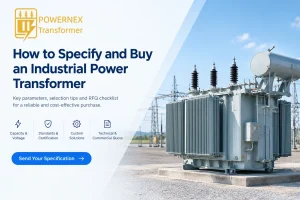
How to Specify and Buy an Industrial Power Transformer
Choosing the right power transformer is an important decision for industrial plants, utilities, EPC contractors, [...]
Sep
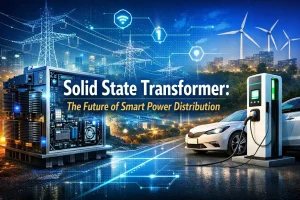
The Future of Power Distribution: Solid State Transformers (SST)
Introduction The Solid State Transformer (SST) is rapidly emerging as a breakthrough technology in modern [...]
Mar
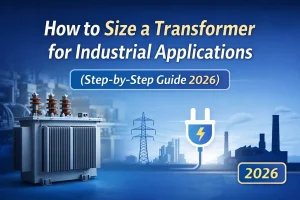
How to Size a Transformer for Industrial Applications in 2026 (Complete Step-by-Step Guide)
Introduction Choosing the correct transformer size for an industrial application is one of the most [...]
Mar
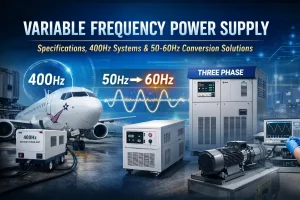
Variable Frequency Power Supply: Industrial Guide to Specifications, Applications, 400Hz Systems & Frequency Conversion Solutions
A Variable Frequency Power Supply (VFPS) is a programmable AC power source designed to convert [...]
Feb