

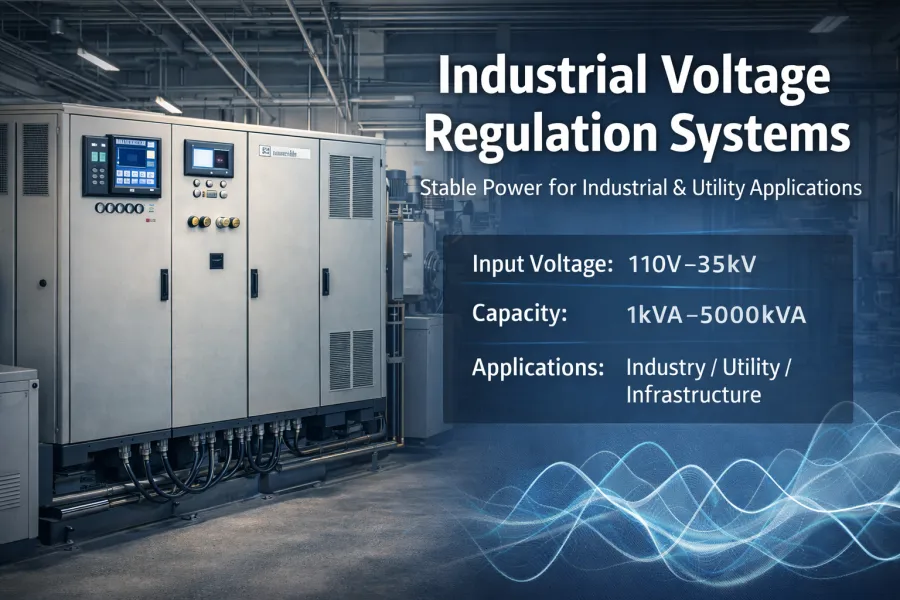
Stable voltage is critical to the safe, efficient, and continuous operation of industrial power systems. Voltage fluctuations caused by unstable grids, load variations, generator operation, or long transmission distances can lead to equipment damage, unexpected downtime, process instability, and increased maintenance costs.
Industrial voltage regulation systems are designed to maintain consistent and reliable output voltage under a wide range of operating conditions. These systems are widely deployed in manufacturing plants, utilities, infrastructure projects, renewable energy facilities, and mission-critical installations across global markets.
This article provides a comprehensive technical and application-oriented overview of industrial voltage regulation systems, covering:
-
Input and output voltage configurations
-
Capacity (kVA) selection principles
-
Low-voltage and medium-voltage applications (up to 35kV)
-
Load-based voltage regulation solutions
-
Real-world industrial application examples
The goal is to help engineers, EPC contractors, system integrators, and industrial buyers design reliable voltage regulation solutions with long-term operational stability.
What Are Industrial Voltage Regulation Systems?
Industrial voltage regulation systems are electrical devices and assemblies used to automatically or manually stabilize voltage supplied to electrical loads. They are commonly integrated with:
-
Motorized Variable Voltage Regulators
-
Transformer-based voltage regulation systems
-
Power distribution panels and MCCs
These systems protect electrical equipment from:
-
Overvoltage and undervoltage
-
Voltage imbalance and fluctuation
-
Grid disturbances and transient instability
-
Generator load variation
They are essential in environments where power quality directly impacts productivity, safety, and asset lifespan.
Common Input Voltage Configurations
Industrial voltage regulation equipment is engineered to accept a wide range of input voltages based on regional grid standards and project requirements.
Low Voltage Input Ranges
| Input Voltage | Typical Applications |
|---|---|
| 110V / 120V | North America, light industrial & control systems |
| 220V / 230V | Single-phase industrial equipment |
| 380V / 400V / 415V | Three-phase industrial power systems |
These ranges cover the majority of factory-level and commercial power distribution environments.
Medium Voltage Input (via Transformer)
For high-capacity and utility-related applications, voltage regulation systems are often combined with dry-type or oil-immersed transformers.
Typical medium-voltage inputs include:
In these systems, the transformer steps voltage down to usable industrial levels, while the voltage regulation system ensures stable, regulated output on the low-voltage side.
Output Voltage Configurations & Regulation Accuracy
Output voltage design depends on whether the application requires stable fixed voltage or adjustable voltage control.
Typical Output Voltage Options
-
Fixed stabilized output (e.g. 380V ±1% / ±2%)
-
Adjustable output voltage (e.g. 300V–430V)
-
Fully customized voltage based on equipment specifications
Regulation Accuracy Levels
| Input Voltage | Typical Applications |
|---|---|
| 110V / 120V | North America, light industrial & control systems |
| 220V / 230V | Single-phase industrial equipment |
| 380V / 400V / 415V | Three-phase industrial power systems |
High regulation accuracy is essential for motors, automation systems, CNC machinery, VFDs, and sensitive control electronics.
Capacity (kVA) Selection for Voltage Regulation Systems
Correct kVA sizing is one of the most critical design factors affecting system reliability and lifespan.
Typical Capacity Range
-
1 kVA – 5000 kVA
-
Single-phase and three-phase systems
Key Factors Affecting kVA Selection
-
Total connected load
-
Motor starting (inrush) current
-
Load diversity and simultaneity
-
Duty cycle (continuous vs intermittent operation)
-
Ambient temperature and ventilation
🔧 Engineering Recommendation:
For motor-driven systems, select 20–30% additional capacity above calculated load to handle starting current and avoid overheating.
Voltage Regulation Solutions for Different Load Scenarios
Motor-Driven Industrial Loads
Used in:
-
Pumps, compressors, conveyors
-
Production lines and processing equipment
Benefits:
-
Reduced current fluctuation
-
Improved efficiency
-
Extended motor and insulation life
Variable Frequency Drive (VFD) Systems
VFDs are highly sensitive to voltage instability. Voltage regulation systems:
-
Prevent nuisance trips
-
Reduce harmonic stress
-
Improve speed control accuracy
Precision Electronic & Control Loads
For PLCs, instrumentation, and control panels:
-
Voltage regulators + isolation transformers
-
Reduced electrical noise
-
Improved system stability
Generator-Powered & Hybrid Systems
In generator-based or off-grid installations:
-
Compensate for load changes
-
Stabilize generator output
-
Improve fuel efficiency and voltage consistency
Typical Technical Parameters of Industrial Voltage Regulation Equipment
-
Rated capacity: 1 kVA – 5000 kVA
-
Input voltage range: 110V – 35kV
-
Output accuracy: ±1% to ±3%
-
Phase type: Single-phase / Three-phase
-
Frequency: 50Hz / 60Hz
-
Cooling: Air-cooled / Oil-immersed
-
Duty cycle: Continuous 24/7 operation
-
Installation: Indoor / Outdoor
Real-World Application Examples
Case 1: Manufacturing Plant (400V, 800kVA)
-
Issue: Frequent voltage dips during peak production
-
Solution: 1000kVA AVR system
-
Result: 30% reduction in equipment faults, improved uptime
Case 2: Renewable Energy Facility (10kV Input)
-
Issue: Voltage fluctuation from grid connection
-
Solution: Transformer + voltage regulation system
-
Result: Stable inverter operation and reduced shutdowns
Case 3: Data Center Support System
-
Issue: Sensitive IT equipment voltage tolerance
-
Solution: High-accuracy voltage regulation
-
Result: Improved power quality and system reliability
Voltage Regulation Equipment for OEM, Wholesale & Project Supply
For EPC contractors, system integrators, and industrial buyers, voltage regulation systems are often delivered as complete engineered solutions.
As a manufacturer-direct factory supplier, PowerNex provides:
-
OEM & ODM voltage regulation systems
-
Factory-controlled production
-
Wholesale and project-based supply
-
Custom input/output voltage design
-
Engineering support for global projects
Products are manufactured to IEC, UL, CE standards and supplied to:
USA, Canada, Brazil, Argentina, Mexico, South Africa, Indonesia, Malaysia, and global markets.
Frequently Asked Questions (FAQ)
What input voltage range can industrial voltage regulators handle?
Low-voltage inputs from 110V–415V and medium-voltage systems up to 35kV with transformers.
How do I select the correct kVA rating?
Base selection on total load, motor starting current, and duty cycle, with capacity margin.
AVR vs variable voltage regulator—what’s the difference?
AVRs automatically stabilize voltage; variable regulators allow manual or motorized adjustment.
Conclusion
Industrial voltage regulation systems are essential for maintaining power stability, protecting assets, and ensuring continuous operation across industrial and utility environments.
By selecting the correct input voltage range, output configuration, and kVA capacity, users can significantly improve system reliability and reduce long-term operating costs.
With in-house engineering, factory-controlled manufacturing, and global project experience, PowerNex delivers reliable voltage regulation solutions tailored to industrial, utility, and infrastructure applications worldwide.