

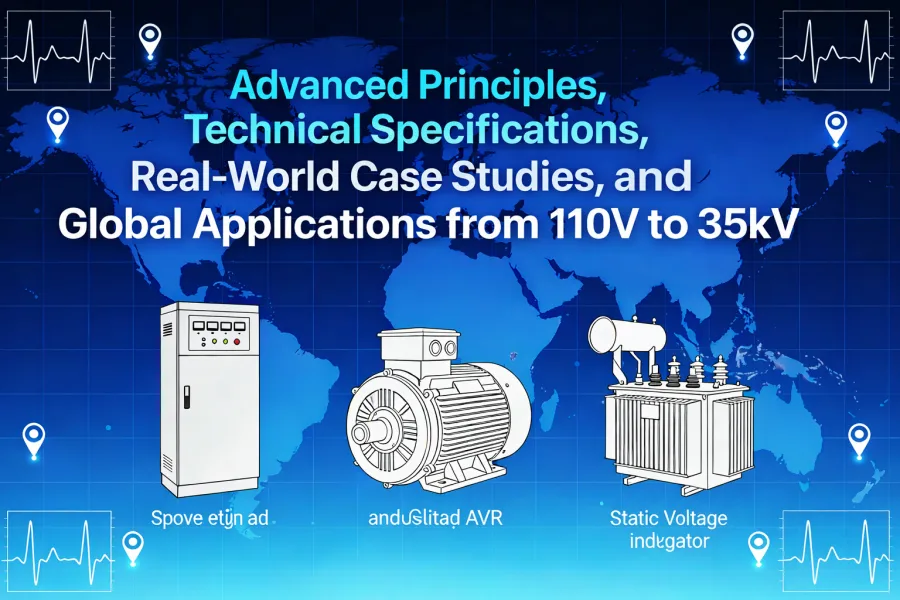
1. Introduction: Voltage Stability as a Core Requirement of Modern Power Systems
Voltage instability is one of the most common causes of electrical equipment failure, unplanned downtime, and reduced energy efficiency in industrial and utility power systems. In real-world grids—especially in developing regions, industrial zones, and renewable energy installations—voltage deviations of ±10% to ±30% are not uncommon.
Automatic Voltage Regulators (AVR) and industrial variable voltage regulation systems are engineered to maintain a constant output voltage under fluctuating supply conditions, ensuring safe, reliable, and efficient operation of electrical loads.
2. What Is an Automatic Voltage Regulator (AVR)?
An Automatic Voltage Regulator is a closed-loop control device that continuously senses the input voltage and automatically adjusts the output voltage to a preset value.
Unlike simple step transformers, AVRs dynamically compensate for voltage fluctuations in real time, without interrupting power delivery.
Typical AVR applications include:
-
Industrial manufacturing lines
-
Utility distribution systems
-
Data centers and hospitals
-
Renewable energy installations
-
Commercial and infrastructure projects
3. Deep Dive: How AVR Systems Actually Work (Control Logic Explained)
3.1 Voltage Sensing & Feedback Loop
At the core of every AVR is a voltage sensing circuit that continuously monitors the input and output voltage. This feedback signal is compared with a reference voltage.
When deviation exceeds the allowable tolerance:
-
Under-voltage → Voltage is boosted
-
Over-voltage → Voltage is reduced
This closed-loop control ensures constant output even during rapid input fluctuations.
3.2 Regulation Mechanisms
Servo Motor Type AVR (Electromechanical)
-
Uses a servo motor to adjust a variable autotransformer
-
High regulation accuracy (±1% to ±3%)
-
Excellent for continuous industrial loads
-
Long service life, easy maintenance
Best for:
Factories, production lines, motor-driven equipment
Static (Electronic) Voltage Regulators
-
Uses thyristors / IGBT-based switching
-
Ultra-fast response (milliseconds)
-
No mechanical movement
Best for:
Sensitive electronics, laboratories, data centers
Hybrid Voltage Regulation Systems
-
Combines servo precision with electronic speed
-
Balances accuracy, response time, and durability
4. Voltage, Capacity & Electrical Parameter Ranges
4.1 Supported Voltage Classes
Low Voltage Systems
-
110V / 120V
-
220V / 230V
-
380V / 400V / 415V
-
480V
Medium Voltage Systems
-
3.3kV
-
6.6kV
-
10kV / 11kV
-
13.8kV
-
Up to 35kV
Frequency
-
50Hz / 60Hz
4.2 Capacity Ranges
-
Single-phase: 1 kVA – 100 kVA
-
Three-phase: 5 kVA – 5000 kVA+
-
Customized ratings for utility and infrastructure projects
5. Input / Output Configurations & Load Compatibility
AVR systems can be engineered for:
-
Wide input voltage tolerance (±15%, ±20%, ±30%)
-
Fixed or adjustable output voltage
-
Delta (Δ) or Wye (Y) connections
-
Single-load or multi-load distribution
-
Manual bypass and maintenance bypass systems
Load Types Supported
-
Inductive loads (motors, compressors)
-
Resistive loads (heaters)
-
Non-linear loads (VFDs, rectifiers, inverters)
-
Mixed industrial loads
6. AVR vs Other Voltage Control Technologies
| System Type | Response | Accuracy | Typical Use |
|---|---|---|---|
| AVR | Medium–Fast | High | Industrial & commercial |
| Variable Voltage Regulator | Medium | High | Manufacturing systems |
| OLTC Transformer | Slow | Medium | Utility substations |
| UPS | Instant | Very High | Critical loads |
AVRs fill the gap between transformer-based voltage control and UPS systems, offering cost-effective, continuous voltage stabilization.
7. Real-World Application Case Studies
Case 1: Automotive Manufacturing Plant (400V, 1500 kVA)
Problem:
Frequent voltage dips during motor startup caused PLC errors and production stoppages.
Solution:
Three-phase servo-type AVR with ±25% input range.
Result:
-
Stable voltage under peak loads
-
Reduced downtime by 40%
-
Extended motor and control system lifespan
Case 2: Solar Power Plant Grid Interface (11kV, 3000 kVA)
Problem:
Inverter trips due to unstable grid voltage.
Solution:
Medium-voltage voltage regulation system integrated with step-up transformer.
Result:
-
Improved grid compliance
-
Reduced inverter protection trips
-
Higher energy yield
Case 3: Commercial Data Center (480V, 800 kVA)
Problem:
Voltage fluctuations causing server alarms.
Solution:
Static AVR system with fast electronic regulation.
Result:
-
Clean and stable voltage
-
Improved system reliability
-
Reduced dependency on UPS cycling
8. Integration with Transformers & Power Distribution Systems
AVRs are frequently deployed alongside:
-
Dry-type transformers
-
Oil-immersed distribution transformers
-
Isolation transformers
-
Variable Frequency Drives (VFDs)
-
Motor Control Centers (MCC)
This integrated system architecture ensures voltage stability, electrical isolation, and optimal load control.
9. Standards, Certifications & Global Compliance
Industrial voltage regulation systems are designed to meet:
-
IEC standards
-
ANSI / IEEE standards
-
UL certification
-
CE conformity
This ensures acceptance across markets including the United States, Canada, South America, Southeast Asia, Africa, and Australia.
10. How to Select the Right AVR System
Key selection criteria include:
-
Nominal voltage and fluctuation range
-
Load type and starting current
-
Required regulation accuracy
-
Environmental conditions
-
Installation location (indoor/outdoor)
-
Local grid and certification requirements
Working directly with a manufacturer allows precise matching of technical and commercial requirements.
11. Conclusion: Intelligent Voltage Regulation for Global Power Infrastructure
Automatic Voltage Regulators and industrial voltage regulation systems are essential components of modern electrical infrastructure. From low-voltage industrial equipment to medium-voltage utility applications up to 35kV, AVR systems provide reliable voltage stability, equipment protection, and long-term operational efficiency.
Designed to cover a wide range of power capacities—including 15kVA, 30kVA, 50kVA, 60kVA, 100kVA, 150kVA, 200kVA, and up to multi-MVA configurations—our voltage regulation solutions support diverse industrial loads, commercial facilities, and utility-scale applications.
With flexible capacity ranges, multiple regulation technologies (servo-controlled, static, and hybrid designs), and global compliance standards, AVR solutions support industrial growth, grid reliability, and energy transition projects worldwide.
PowerNex delivers factory-manufactured, engineered voltage regulation solutions for OEM, wholesale, and project-based applications—supporting global markets with stable, reliable power control.