
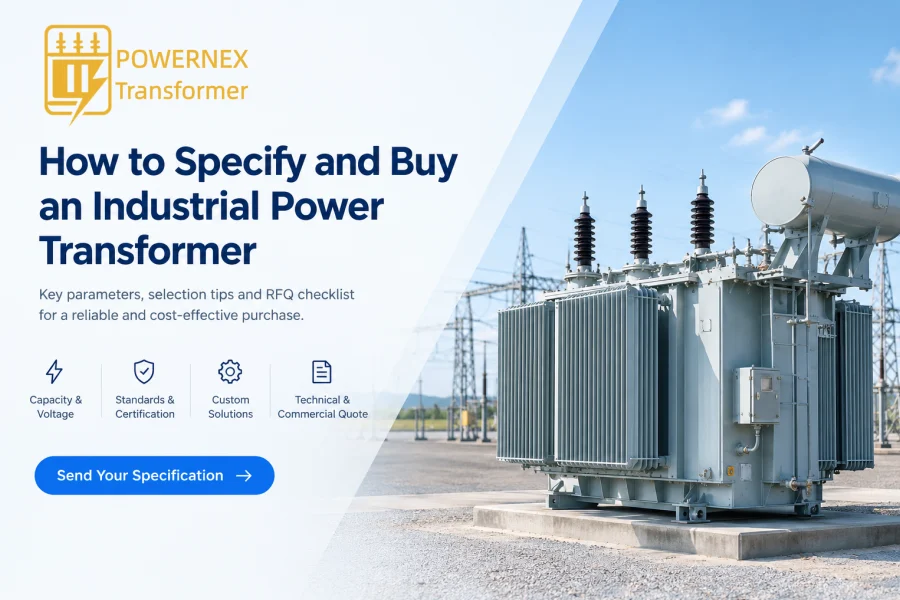
Choosing the right power transformer is an important decision for industrial plants, utilities, EPC contractors, infrastructure projects, oil and gas facilities, renewable energy systems, and commercial power networks. Transformer capacity, voltage, frequency, impedance, insulation level, cooling method, applicable standards, and site conditions all affect system reliability and project cost.
Whether you are looking for a power transformer, distribution transformer, dry type transformer, oil immersed transformer, or custom transformer, the correct specification should be confirmed before requesting a quotation.
What Information Is Required for a Transformer Quotation?
A transformer manufacturer normally needs the following information to prepare a technical and commercial proposal:
- Rated capacity: kVA or MVA
- Primary voltage
- Secondary voltage
- Frequency: 50 Hz or 60 Hz
- Number of phases
- Transformer type
- Cooling method
- Transformer impedance
- Insulation level and BIL
- Tap changer requirements
- Winding material
- Indoor or outdoor installation
- Ambient temperature and altitude
- Applicable standards
- Quantity required
- Project location and delivery destination
If you already have a technical specification, single-line diagram, BOQ, load list, or existing transformer nameplate, sending these documents to the manufacturer can significantly simplify the quotation process.
How to Select Transformer Capacity
Transformer capacity should be selected according to the actual electrical load rather than simply choosing the nearest standard rating.
Industrial projects may require additional capacity for:
- Motor starting current
- Continuous heavy loads
- Future plant expansion
- Load growth
- Harmonic loads
- Emergency or standby requirements
Power transformers and distribution transformers are available in a wide range of capacities, from small kVA units to large MVA-class transformers. The final rating should be confirmed according to the project load profile and electrical system design.
How to Select the Correct Voltage
The primary and secondary voltage must match the electrical distribution system.
Common project requirements include:
- 11 kV to 400 V
- 11 kV to 415 V
- 13.8 kV to 480 V
- 22 kV to 400 V
- 33 kV to 415 V
- 34.5 kV to low-voltage systems
For international projects, the transformer should be designed according to the actual system voltage, highest system voltage, insulation requirements, frequency, and connection arrangement specified by the project.
Oil-Immersed or Dry Type Transformer?
Both oil immersed transformers and dry type transformers are widely used, but their applications are different.
Oil immersed transformers are commonly selected for utility networks, industrial facilities, outdoor substations, large distribution systems, renewable energy projects, mining, and oil and gas applications.
Dry type transformers are often preferred for buildings, data centers, commercial facilities, hospitals, indoor substations, and installations where oil-free operation is required.
The best transformer type depends on the installation environment, capacity, fire-safety requirements, maintenance strategy, and project specifications.
Transformer Standards and Certifications
International transformer projects may specify different standards depending on the country, electrical system, and project owner.
Common standards include:
- IEC 60076
- IEEE C57 series
- ANSI
- NEMA
- DOE energy-efficiency requirements
- UL requirements where applicable
For EPC and industrial projects, the applicable standard should always be confirmed from the project specification. Additional factory tests, type tests, special documentation, or certification may also be required for project approval.
Special Transformer Requirements for Industrial Projects
Industrial and infrastructure projects may require customized transformer designs rather than standard catalog products.
Typical special requirements can include:
- High ambient temperature operation
- Outdoor installation
- High short-circuit withstand capability
- Special impedance
- Higher insulation level
- Harmonic-load applications
- K-factor requirements
- Corrosion protection
- Special enclosure
- Customized terminals
- Special monitoring and protection accessories
Oil and gas, mining, power generation, renewable energy, and large industrial projects often require detailed technical compliance before a transformer supplier can be approved.
What Should You Check Before Buying a Transformer?
Before placing a transformer order, buyers should confirm:
1. Electrical compatibility
Verify voltage, capacity, frequency, phase, impedance, and connection group.
2. Applicable standards
Confirm whether the project requires IEC, IEEE, ANSI, NEMA, UL, DOE, or other standards.
3. Efficiency and losses
Compare no-load losses, load losses, and total operating costs rather than purchasing based only on the initial price.
4. Factory testing
Confirm the required routine tests and any additional type, special, or factory acceptance tests.
5. Installation conditions
Check ambient temperature, altitude, indoor/outdoor installation, ventilation, space limitations, and environmental conditions.
6. Documentation
A project transformer supplier should be able to provide technical datasheets, drawings, test reports, manuals, nameplate information, and other required documentation.
Why Work Directly With a Transformer Manufacturer?
For project-based procurement, working directly with a transformer manufacturer can provide greater flexibility than purchasing a standard product through a trading company.
A qualified manufacturer can review project specifications, customize voltage and capacity, select suitable materials and accessories, provide technical documentation, perform factory testing, and support EPC contractors and distributors throughout the procurement process.
For large orders, direct factory supply can also simplify communication between the engineering, procurement, and manufacturing teams.
Request a Transformer Technical & Commercial Proposal
PowerNex supplies customized power transformers and distribution transformers for industrial, utility, oil and gas, mining, renewable energy, infrastructure, and commercial projects.
If you are planning a transformer purchase, send us your technical specification, required capacity and voltage, quantity, project location, or single-line diagram.
Our engineering team can review your requirements and provide a suitable transformer solution together with a technical proposal and commercial quotation.
Need a transformer for your project? Send your specifications to PowerNex and request a factory-direct quotation.