
In modern power systems, transformers play a critical role in voltage conversion to ensure safe, efficient, and reliable electricity transmission and distribution. Among the most commonly used types are Step-Up Transformers and Step-Down Transformers (sometimes informally referred to as “set up” and “set down” transformers).
Understanding the differences between these two transformer types is essential for industrial plants, utility networks, renewable energy projects, and infrastructure developments. This guide explains how they work, where they are used, and how to select the right solution for your project.
What Is a Step-Up Transformer?
A Step-Up Transformer is designed to increase voltage from the input (primary side) to the output (secondary side) while proportionally reducing current. This type of transformer is widely used where electrical power must be transmitted over long distances with minimal energy loss.
Key Characteristics of Step-Up Transformers
-
Output voltage higher than input voltage
-
Lower output current
-
Reduced transmission losses
-
Typically used at power generation or renewable energy facilities
Common Applications
-
Power plants (thermal, hydro, nuclear)
-
Solar and wind power projects (collector stations and grid interconnection)
-
Utility substations for high-voltage transmission
-
Industrial facilities exporting power to the grid
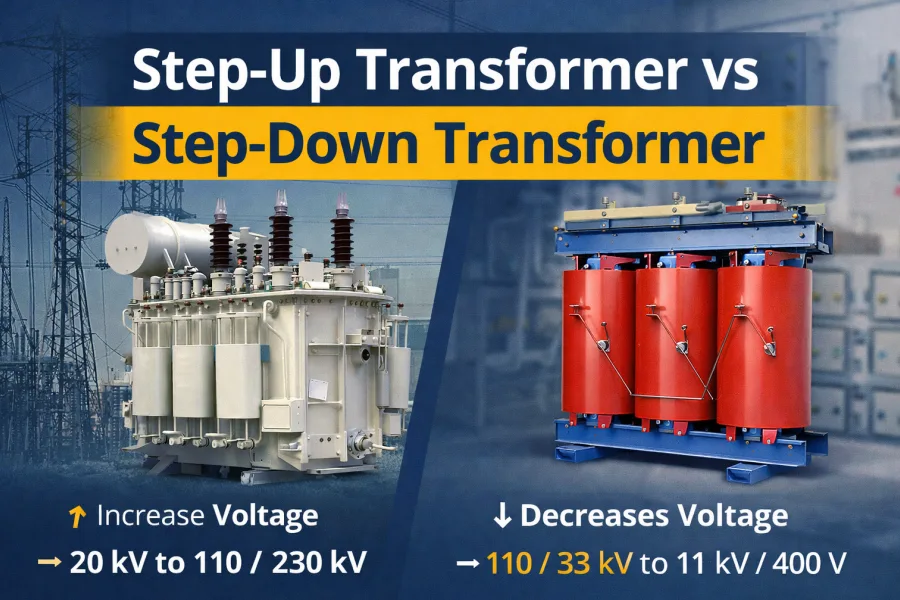
For example, in a solar power plant, electricity generated at 20 kV or 35 kV is stepped up to 110 kV, 220 kV, or higher for efficient transmission to the utility grid.
What Is a Step-Down Transformer?
A Step-Down Transformer performs the opposite function—it reduces voltage from a higher level to a lower, usable level, making electricity safe for end users and equipment.
Key Characteristics of Step-Down Transformers
-
Output voltage lower than input voltage
-
Higher output current
-
Designed for safe power utilization
-
Installed closer to end users
Common Applications
-
Distribution substations
-
Industrial plants and factories
-
Commercial buildings and data centers
-
Infrastructure and municipal power systems
Typical examples include reducing voltage from 110 kV or 33 kV down to 11 kV, 400 V, or 230 V for industrial machinery or building power distribution.
Step-Up vs Step-Down Transformer: Key Differences
| Aspect | Step-Up Transformer | Step-Down Transformer |
|---|---|---|
| Voltage Function | Increases voltage | Decreases voltage |
| Current Level | Lower output current | Higher output current |
| Typical Location | Generation side | Load / consumption side |
| Main Purpose | Long-distance transmission | Safe power utilization |
| Common Voltage Range | 20 kV → 110 / 220 / 230 kV | 110 / 33 kV → 11 kV / 400 V |
Dry Type vs Oil-Immersed Design for Step-Up and Step-Down Transformers
Both step-up and step-down transformers can be designed using different insulation and cooling technologies:
Dry Type Transformers
-
Typically used for low and medium voltage
-
Fire-safe and environmentally friendly
-
Ideal for indoor installations, commercial buildings, and data centers
Oil-Immersed Transformers
-
Suitable for medium and high voltage applications
-
Higher efficiency and overload capability
-
Commonly used in utilities, substations, and renewable energy projects
At high-voltage levels (110 kV, 220 kV, 230 kV), step-up and step-down transformers are almost exclusively oil-immersed power transformers.
How to Choose the Right Transformer for Your Project
When selecting a step-up or step-down transformer, consider the following key factors:
-
Input and Output Voltage Requirements
Clearly define the primary and secondary voltage levels. -
Rated Power Capacity (kVA / MVA)
Ensure sufficient margin for load growth and peak operation. -
Application Environment
Indoor vs outdoor, temperature, altitude, and installation conditions. -
Cooling Method
AN, AF, ONAN, ONAF, or customized cooling solutions. -
Standards and Certifications
IEC, IEEE, ANSI, CE, UL, CSA, or other regional requirements. -
Future Expansion and Reliability
Long-term performance, efficiency, and maintenance considerations.
PowerNex Step-Up and Step-Down Transformer Solutions
PowerNex specializes in the design and manufacture of step-up and step-down transformers for industrial, utility, and renewable energy applications. Our product range includes:
-
Dry type and oil-immersed transformers
-
Distribution and power transformers
-
Voltage classes from low voltage up to 230 kV
-
Custom-engineered solutions for EPC and IPP projects
All PowerNex transformers are manufactured in compliance with IEC, IEEE, ANSI, CE, UL, CSA, and GOST standards, ensuring safe, reliable, and efficient operation across global markets.
Conclusion
Both Step-Up Transformers and Step-Down Transformers are essential components of modern power systems. Choosing the right type—and the right manufacturer—directly impacts system efficiency, safety, and long-term reliability.
If you are planning an industrial facility, utility substation, or renewable energy project, PowerNex provides proven transformer solutions engineered to meet your exact voltage, capacity, and compliance requirements.
👉 Contact PowerNex today to discuss your step-up or step-down transformer needs.