

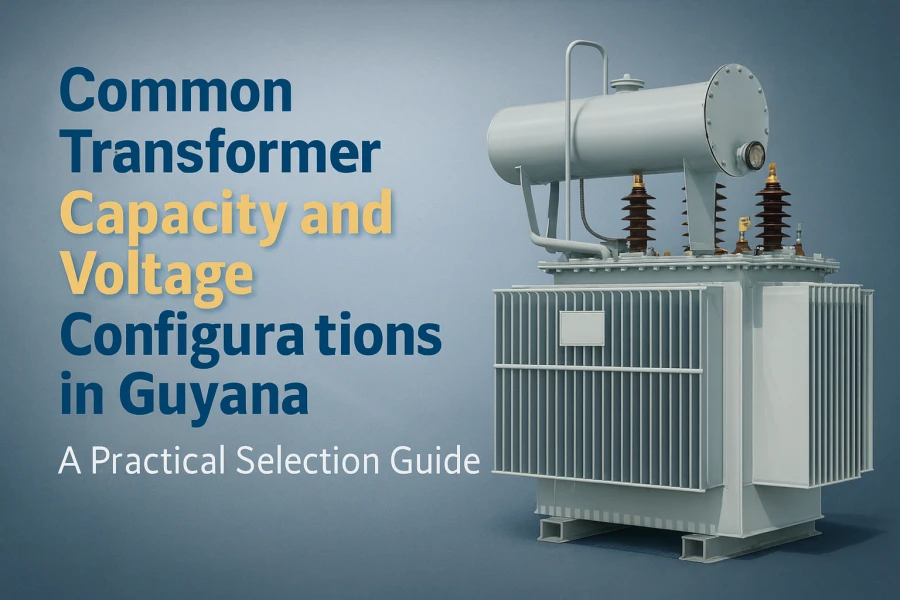
As power infrastructure projects continue to expand across Guyana, utilities, EPC contractors, and industrial developers are increasingly required to select the correct transformer capacity and voltage configuration for their applications. Choosing the wrong specification can result in inefficiency, voltage instability, higher losses, or unnecessary cost.
This guide provides a practical overview of commonly used transformer capacities and voltage levels in Guyana, explains how they are applied in real projects, and offers guidance on how to specify transformers correctly when sourcing from international manufacturers.
Overview of Distribution Voltage Levels in Guyana
Guyana’s power distribution system follows internationally common medium-voltage standards, particularly for utility and industrial networks.
The most widely used medium voltage primary levels include:
-
12.47 kV
-
13.2 kV
-
13.8 kV
These voltage levels are typically stepped down to low voltage for end users through distribution transformers installed on poles, pads, or substations.
On the low voltage secondary side, common configurations include:
-
480Y/277 V for commercial and industrial facilities
-
208Y/120 V for mixed-use and light commercial loads
-
400Y/230 V or 415 V in selected industrial or international-standard projects
Understanding these voltage pairings is essential for ensuring compatibility with local equipment and grid requirements.
Common Transformer Capacity Ranges Used in Guyana
Transformer capacity selection in Guyana depends heavily on application type, load profile, and future expansion plans.
Small Capacity Transformers: 25 kVA – 150 kVA
This range is typically used for:
-
Residential distribution
-
Small commercial buildings
-
Rural and suburban overhead networks
Pole mounted transformers dominate this segment due to their lower cost and simple installation.
Medium Capacity Transformers: 300 kVA – 750 kVA
Transformers in this range are widely applied in:
-
Commercial buildings
-
Light industrial facilities
-
Urban distribution networks
Both pole mounted and pad mounted transformers are commonly used, depending on whether overhead or underground distribution is adopted. Typical voltage configurations include 13.8 kV to 480Y/277 V or 208Y/120 V.
Large Distribution Transformers: 1000 kVA – 2500 kVA
This capacity range is frequently specified for:
-
Industrial plants
-
Utility substations
-
Infrastructure projects such as hospitals, airports, and data facilities
These transformers are usually three phase oil filled units installed in substations or pad-mounted enclosures, designed for continuous operation and higher fault withstand capability.
High Capacity Transformers: 3000 kVA and Above
High-capacity transformers are used in:
-
Central utility substations
-
Large industrial and mining operations
-
Renewable energy and infrastructure projects
These units often feature customized impedance, cooling methods such as ONAN or ONAF, and enhanced insulation systems to handle high load and environmental stress.
Matching Capacity with Load Requirements
Accurate load assessment is critical when selecting transformer capacity.
Key factors to consider include:
-
Peak demand versus average load
-
Motor starting currents and inrush conditions
-
Future load expansion
-
Power factor and harmonic content
In many Guyana projects, transformers are sized with 15–30% capacity margin to accommodate growth and improve long-term reliability.
Typical Voltage and Capacity Pairings in Guyana Projects
Below are commonly specified combinations used across utility and industrial projects:
-
500 kVA, 13.8 kV / 480Y/277 V
-
750 kVA, 13.2 kV / 208Y/120 V
-
1000 kVA, 12.47 kV / 480Y/277 V
-
1250 kVA, 13.8 kV / 480Y/277 V
-
2500 kVA, 13.8 kV / 400Y/230 V
These configurations are widely supported by international transformer manufacturers and are readily customizable.
Environmental and Installation Considerations in Guyana
Guyana’s climate presents unique challenges for transformer operation.
Important design considerations include:
-
High humidity and rainfall
-
Coastal corrosion exposure
-
Elevated ambient temperatures
-
Outdoor installation requirements
As a result, oil filled transformers supplied to Guyana often feature sealed tanks, corrosion-resistant coatings, and insulation systems designed for tropical conditions.
Standards and Compliance Requirements
Most transformer projects in Guyana specify compliance with:
-
ANSI standards for utility-driven projects
-
IEC standards for international EPC or industrial projects
-
IEEE test procedures for performance verification
Buyers should clearly define standard requirements during procurement to ensure compatibility with grid codes and inspection processes.
Sourcing Transformers from China for Guyana Projects
China has become a primary sourcing destination for transformers used in Guyana due to:
-
Competitive factory-direct pricing
-
Broad capacity and voltage customization
-
Experience supplying Latin America and Caribbean markets
-
Ability to meet ANSI, IEC, and IEEE standards
Successful procurement depends on clear technical specifications, drawing approval, and factory testing before shipment.
PowerNex: Customized Transformer Solutions for Guyana
PowerNex is a China-based power transformer manufacturer specializing in pole mounted transformers, pad mounted transformers, and three phase oil filled distribution transformers up to 35 kV.
For Guyana projects, PowerNex provides:
-
Customized capacity and voltage configurations
-
Factory-direct wholesale supply
-
Compliance with international standards
-
Support for utility, industrial, and infrastructure applications
This approach ensures that transformers are tailored to real operating conditions rather than generic specifications.
Conclusion
Selecting the correct transformer capacity and voltage configuration is a critical step in ensuring reliable and efficient power distribution in Guyana. By understanding common voltage levels, typical capacity ranges, and application requirements, utilities and project developers can make informed procurement decisions.
With experienced manufacturers such as PowerNex, Guyana buyers can source reliable, customized transformer solutions that support both current demand and future growth.