

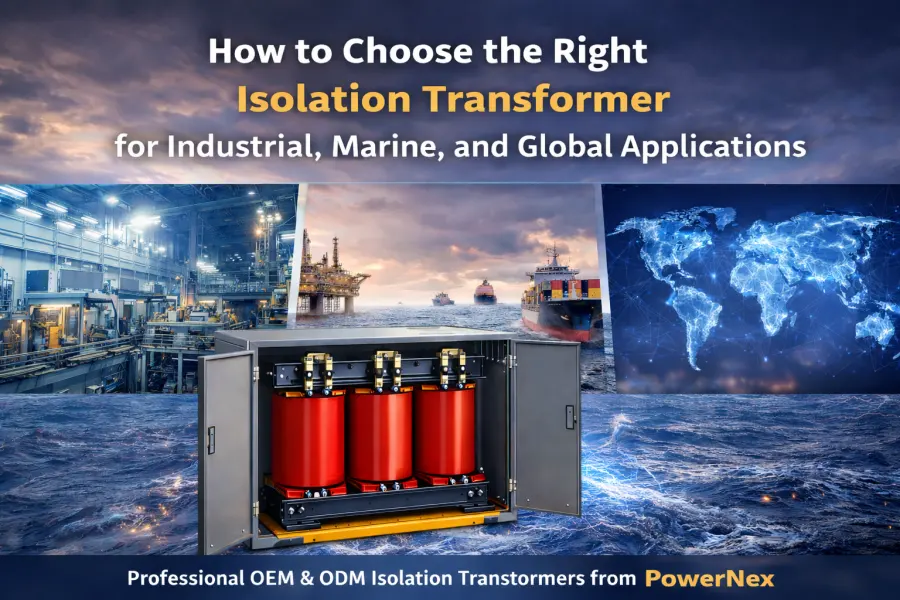
Selecting the right isolation transformer is a critical decision for industrial plants, marine vessels, offshore platforms, and commercial power systems. An incorrect choice can lead to equipment failure, safety risks, voltage instability, and long-term operational losses.
With increasing globalization, power systems must now operate across different voltage standards, frequencies, environments, and compliance requirements. This makes transformer selection even more complex.
As a leading Chinese isolation transformer manufacturer, supplier, wholesaler, and factory, PowerNex supports global customers with OEM & ODM transformer solutions for industrial, marine, and offshore applications across the USA, Canada, Brazil, Argentina, Australia, Indonesia, Malaysia, Philippines, UAE, Saudi Arabia, Russia, Germany, France, South Africa, Mexico, New Zealand, and other international markets.
This guide explains how to choose the right isolation transformer based on application, voltage, capacity, environment, and global standards.
Step 1: Define the Application Scenario
The first step in transformer selection is understanding where and how the transformer will be used.
Common Application Types
-
Industrial factories (automation, CNC, PLC systems)
-
Marine vessels (cargo ships, ferries, cruise ships)
-
Offshore platforms (oil & gas, offshore substations)
-
Ports and shipyards
-
Commercial and infrastructure projects
Each application has unique requirements related to safety, durability, and power stability.
Step 2: Determine Voltage and Frequency Requirements
Global Voltage Standards
Different regions operate under different electrical standards:
North America (USA, Canada)
-
120V / 240V, 60Hz (single-phase)
-
208V / 480V, 60Hz (three-phase)
Europe (Germany, France, UK)
-
230V / 400V, 50Hz
Middle East (UAE, Saudi Arabia)
-
220–240V / 380–415V, 50Hz
Asia-Pacific (Australia, Indonesia, Malaysia, Philippines)
-
220–240V, 50Hz
Latin America & Africa (Brazil, Argentina, South Africa, Mexico)
-
Mixed standards: 110–240V, 50/60Hz
PowerNex isolation transformers support a wide voltage range from 110V to 690V, including custom input/output combinations for international projects.
Step 3: Select the Correct Power Capacity
Typical Capacity Ranges
Isolation transformers are commonly available in capacities from:
-
5 kVA
-
10 kVA
- 15 KVA
-
30 kVA
-
50 kVA
-
100 kVA
-
250 kVA
-
500 kVA
-
1000 kVA and above
Capacity Selection Tips
-
Calculate total connected load
-
Add 20–30% safety margin
-
Consider motor starting current
-
Account for future expansion
For industrial and marine systems, under-sizing a transformer is one of the most common causes of overheating and early failure.
Step 4: Choose Single-Phase or Three-Phase Configuration
Single-Phase Isolation Transformers
-
Small equipment
-
Control systems
-
Lighting and auxiliary circuits
Three-Phase Isolation Transformers
-
Industrial machinery
-
Marine propulsion systems
-
Offshore automation and power distribution
PowerNex offers single-phase and three-phase isolation transformers with flexible winding configurations such as Delta–Delta, Delta–Star, Star–Star, and customized grounding schemes.
Step 5: Consider Environmental and Installation Conditions
Industrial Environment
-
Dust and vibration
-
High load cycles
-
Indoor or semi-outdoor installation
Marine & Offshore Environment
-
High humidity
-
Salt corrosion
-
Continuous vibration
-
Limited maintenance access
Recommended features include:
-
IP54 / IP55 / IP65 enclosures
-
Anti-corrosion coating
-
Marine-grade insulation
-
Shock-resistant mounting
Step 6: Insulation Class and Thermal Design
Insulation Class Options
-
Class B (130°C)
-
Class F (155°C)
-
Class H (180°C)
Marine and offshore applications typically require Class F or Class H insulation for enhanced thermal endurance and reliability.
Cooling Methods
-
Air Natural (AN)
-
Air Forced (AF)
PowerNex designs transformers for ambient temperatures up to 55°C, suitable for Middle East, tropical, and offshore environments.
Step 7: Compliance and Certification
Choosing a transformer that meets local and international standards is essential for project approval and long-term operation.
Common standards include:
-
IEC 60076
-
IEC 61558
-
CE Certification
-
UL (on request)
-
Marine standards: ABS, DNV, BV (project-based)
Step 8: OEM & ODM Customization Options
Standard transformers may not meet all project requirements. OEM & ODM services allow full customization, including:
-
Voltage and frequency
-
Capacity and phase configuration
-
Enclosure size and material
-
Branding and labeling
-
Special protection or monitoring features
PowerNex provides factory-direct OEM & ODM isolation transformer solutions for global industrial and marine projects.
Case Study: Multi-Country Industrial Project
Project Scope:
Supply isolation transformers for an industrial automation project across Europe and Southeast Asia.
Specifications:
-
Voltage: 400V / 230V
-
Frequency: 50Hz
-
Capacity: 250kVA–630kVA
-
Insulation: Class F
-
Enclosure: IP54
Results:
-
Full compliance with regional standards
-
Stable operation across different power grids
-
Reduced downtime and maintenance costs
Common Mistakes to Avoid
-
Ignoring environmental conditions
-
Underestimating power capacity
-
Overlooking certification requirements
-
Choosing suppliers without manufacturing capability
Why Choose PowerNex
-
Chinese leading manufacturer and factory
-
Full OEM & ODM capability
-
Wide voltage range: 110V–690V
-
Capacity range: 5kVA–1000kVA+
-
Global supply and fast delivery
-
Long-term technical support
PowerNex serves customers across USA, Canada, Brazil, Argentina, Australia, Indonesia, Malaysia, Philippines, UAE, Saudi Arabia, Russia, Germany, France, South Africa, Mexico, New Zealand, and more.
Conclusion
Choosing the right isolation transformer requires careful evaluation of application, voltage, capacity, environment, and compliance. With the right technical partner, businesses can ensure safe, stable, and long-lasting power systems.
Contact PowerNex today to discuss OEM & ODM isolation transformer solutions tailored to your industrial, marine, or offshore project requirements.